



Every July, Dykema DSO brings 2,300+ dental industry pros together for a mid-year check-in—how is the year tracking against goals, what’s shifted since last year, and what should DSOs be planning for heading into 2027? It’s one of the best rooms in dental for comparing notes with peers and getting a real read on where the industry is headed.
Timing is the whole point. You can’t wait until Q4 to start planning for next year. By then, budgets are locked, and the window to course-correct has closed. Q3 is when that planning work actually needs to start, and Dykema is where much of the thinking behind it is shaped.
If you weren’t able to attend Dykema DSO this year, here are our top takeaways from the event to help you prepare for a stronger year-end.
First up, Planet DDS presented its 2026 mid-year benchmarks, drawn from over 8,000 practices, showing the industry inching forward rather than stalling or surging. Average case acceptance is 61%, up from 58% in 2025. Case completion sits at 49%, up from 47%. New patient volume averages 47/month, up from 46. Modest gains across the board—dental isn’t stagnant, but it isn’t accelerating either. That backdrop matters for what follows: incremental growth means practices can’t afford to leak revenue anywhere in the funnel, which is exactly where staffing and AI come in.
That same theme ran through the event. In his session, “Four Levers of Driving Organic Same-Store Growth in 2025,” Amol Nirgudkar, CEO of Patient Prism, made a similar point. Growth right now is coming from unlocking the production already sitting inside your existing locations—capacity, efficiency, and the patients you’re already generating but not fully converting. That backdrop is exactly why the takeaways below matter.
The staffing problem
Dental organizations are still struggling to hire front office staff and hygienists, driven by two forces:
- Talent shortage, since these roles compete with similar-paying jobs elsewhere
- Wage compression, which is pushing labor costs up as practices fight to attract and retain people.
Together, this caps growth directly; without enough hygienists and appointment capacity, DSOs can’t increase patient volume, no matter how much demand there is.
AI as the enabler
DSOs are turning to AI to offset the staffing gap on 2 fronts:
- Front office (AI answering calls, routing inquiries, handling scheduling so staff aren’t just manning phones)
- Clinical operations (tools making dentists and hygienists more efficient in-chair).
Patient Prism’s analysis of more than 12 million patient calls found that voicemail rates within large dental organizations range from 20% to 40%—meaning a significant share of patients actively seeking care never immediately connect with a member of the practice team. Those missed connections often become lost opportunities entirely, as patients move on when they can’t reach a practice or don’t get timely follow-up. That’s exactly the kind of gap AI-powered call handling is built to close.
The framing at the event was AI as an enabler of capacity and growth, not a replacement. AI isn’t replacing front-office or clinical staff; it’s evolving how they spend their time—redirecting them from repetitive phone/admin work to higher-value patient interactions.
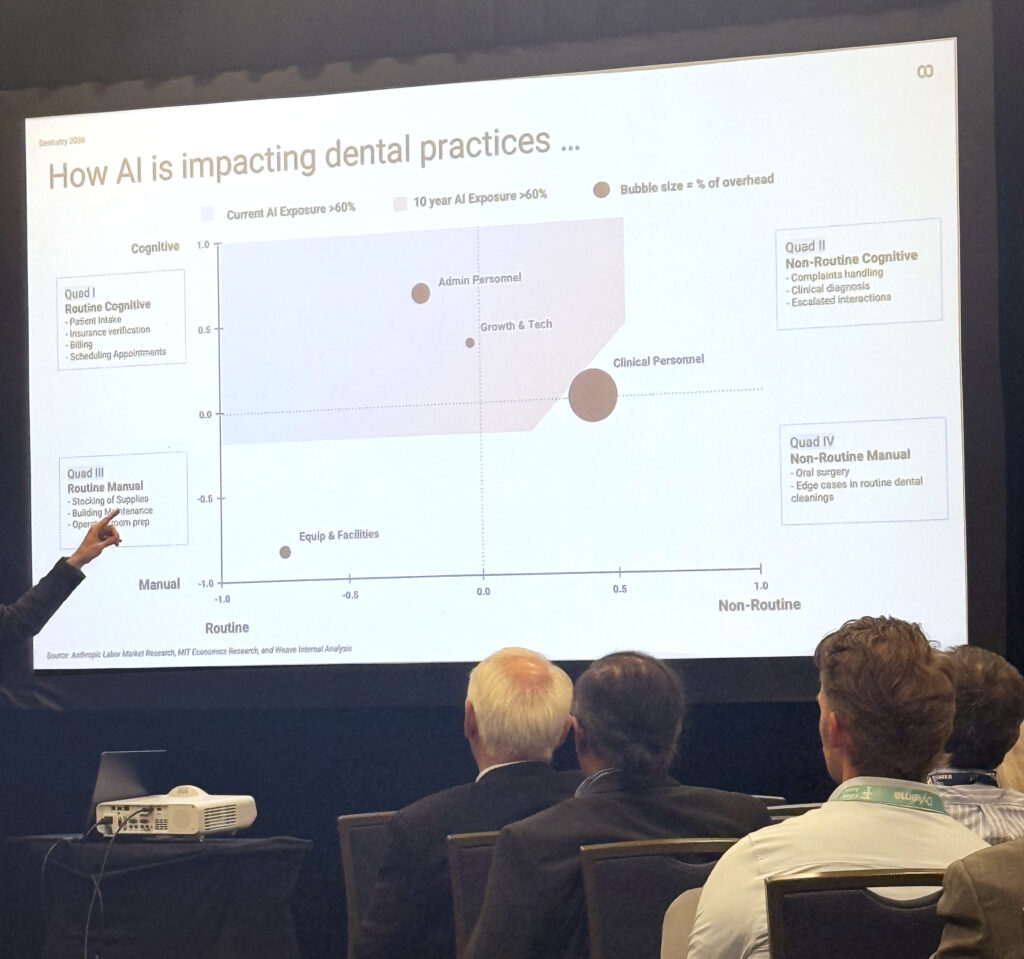
Weave’s Dykema breakout, “A Letter from 2036,” mapped where AI adoption actually sits today. Right now it’s concentrated in Quadrant I (routine, cognitive work: patient intake, insurance verification, billing, scheduling). That’s the easy win. But the trend line is already moving into Quadrant II (non-routine cognitive work, such as complaint handling, clinical diagnosis, and escalated interactions). AI isn’t just automating the predictable stuff anymore; it’s starting to take on judgment calls that used to require a person in the room. That trajectory is what practices should be planning around, not just where things stand today.
On the clinical side, Overjet is an FDA-cleared AI platform that analyzes X-rays to flag cavities and bone loss with far more precision than the eye alone. One of our own clients, The Smilist, uses it and reports catching up to 43% more cavities on bitewing X-rays and 45.8% more on periapical X-rays, while also giving patients clearer, more visual explanations of their own treatment plans.
The dental industry has eagerly embraced AI, consistent with its history of leading healthcare in consolidation, tech adoption, and operational efficiency.
Why it matters to marketers
Broken patient experience burns ad budget, not just goodwill. Someone sees your ad, or Googles you when ready to book. They click through, ready to convert. Then it breaks: no online scheduling, or a phone that no one picks up. Not only are you losing new patients, but you’re wasting ad budget. Before pushing more ad spend, launching a location, or bringing on an acquisition, you need the patient experience to be solid first.
Capacity alignment: with staffing shortages limiting the number of available slots, marketing can’t treat every location the same. You need to know which locations have real availability, which are maxed out, and which are onboarding a new doctor and need a push. Without that visibility, you’re as likely to burn budget sending patients to a location that can’t see them as you are to grow.
This is exactly where AI ties back in, and it’s working on both problems at once.
On the front end, AI is helping front office teams actually answer the phone and deliver the booking experience your ad budget is counting on. On the back end, AI is making clinical and front-office teams more efficient, which opens up real appointment capacity—and growth opportunities—that didn’t exist before.
That’s good news, but it doesn’t solve the alignment problem on its own; it just means the picture is changing faster. Marketing still needs to know where that new capacity is showing up. If anything, AI makes staying in sync with operations more urgent, not less.
One line from that same Weave session sums up the stakes well: the non-negotiable for the next decade is transforming the front office from an admin center into a growth engine. That’s the same reframe marketers should be pushing internally—the front desk isn’t just where operational friction lives; it’s where AI-enabled efficiency turns directly into more booked patients and a better return on the ad spend that got them there.
Maintaining the human touch in healthcare
There’s a real fear running through healthcare right now: that AI adoption means losing the human element patients actually want. That fear is understandable, but it’s based on the wrong assumption. AI isn’t here to replace the people in your practice—it’s here to give them their time back.
Right now, front office teams and clinicians spend much of their day on repetitive, low-value tasks: answering the same scheduling questions, chasing down insurance details, and documenting routine notes. None of that builds a relationship with the patient. When AI takes that work off their plate, it frees your people to do the part of the job that actually matters—listening, explaining, reassuring, connecting. AI doesn’t make care less human. Done well, it makes more room for the human part.
That’s the lens practices should use when evaluating any AI investment: does this let your people deliver a better patient experience, or does it just automate for automation’s sake? The practices that keep the patient at the center—and use AI to free up their team rather than replace their team—are the ones that will differentiate. The ones who lose sight of that and let AI become the face of the practice risk feeling like just another impersonal system in a market that already has plenty of those.
Differentiation is the real prize here. In a crowded, consolidating dental market, “we use AI” isn’t a differentiator anymore—most DSOs already do. “We use AI to make our patients feel more cared for, not less” is.
That’s ultimately what turns unlocked capacity into lasting same-store growth, so you’re not just filling more appointment slots, but giving patients a reason to stay.
