




Behavioral health marketers are carrying a lot heading into 2026. Talent shortages continue, competition is rising, and patient trust keeps slipping. At the same time, expectations from leadership are shifting. It’s no longer enough to generate leads. You’re expected to drive revenue, expand access, and demonstrate impact with clarity.
Table of Contents
- 1. You need sharper differentiation
- 2. AI-driven search is raising the bar on authority
- 3. You’re marketing to more than one decision-maker
- 4. Staffing shortages make capacity your new guardrail
- 5. Patient trust is slipping
- 6. ROI measurement is the baseline
- 7. The paid search ceiling is real
- 8. Messaging must be simple to be effective
- 9. Operationally readiness can’t be ignored
- 10. Strong marketing + operations partnerships drive results
- The bottom line: efficiency and clarity define 2026
The advantage: these same pressures are showing exactly where behavioral health marketing needs to evolve. The organizations that make progress in 2026 will focus on amplifying their strengths, simplifying their message, and aligning tightly with clinical and operational realities.
This guide walks through the major trends shaping behavioral health marketing and the practical adjustments that matter most.
1. You need sharper differentiation
The market continues to expand, with more provider choices, new care models, and changing patient preferences. Being present isn’t enough. Patients want a clear reason to choose you.
Most behavioral health brands still sound the same: compassionate care, evidence-based treatment, support when you need it. Helpful ideas, but not differentiators.
What works is a specific, believable claim. Something you can prove with real stories, outcomes, or expertise. Maybe it’s a treatment approach you excel at, unusually fast access to care, a team with specialized expertise, or a continuity-of-care model that patients value.
A few ways to pressure-test your differentiator:
- Ask recent patients why they chose you
- Interview clinical leaders about what they see as your strengths
- Look for outcome patterns, specialty depth, or program focus
Once you know what makes you different, build it into your messaging, your landing pages, and your paid media strategy. Patients who choose you for a specific strength tend to stay longer and engage more deeply in treatment.
Differentiation is often rooted in understanding the lived experience of the people you serve. Local context matters. Cultural nuance matters. Patients want to see themselves reflected in your values and communication, not just your services.
Adelie Landis, Senior Director of Marketing at Elite DNA Behavioral Health, described their approach this way:
“We use demographic research and personas to make sure that people can see themselves in our creative. That’s really our objective: to inspire people, make them feel safe, and develop that trust as a brand, and that our mental health is in your DNA. That’s really our commitment to you by being in your community.”
Her perspective reinforces one of the most important aspects of differentiation in behavioral health: patients choose organizations that feel rooted in their community and attentive to who they are.
Differentiation isn’t a branding exercise. It is a growth enabler that filters in the right patients and builds credibility early in the journey.
2. AI-driven search is raising the bar on authority
Search is shifting. Keyword stuffing and generic mental health content no longer surface reliably. AI systems reward organizations that demonstrate real clinical expertise and clear topical focus.
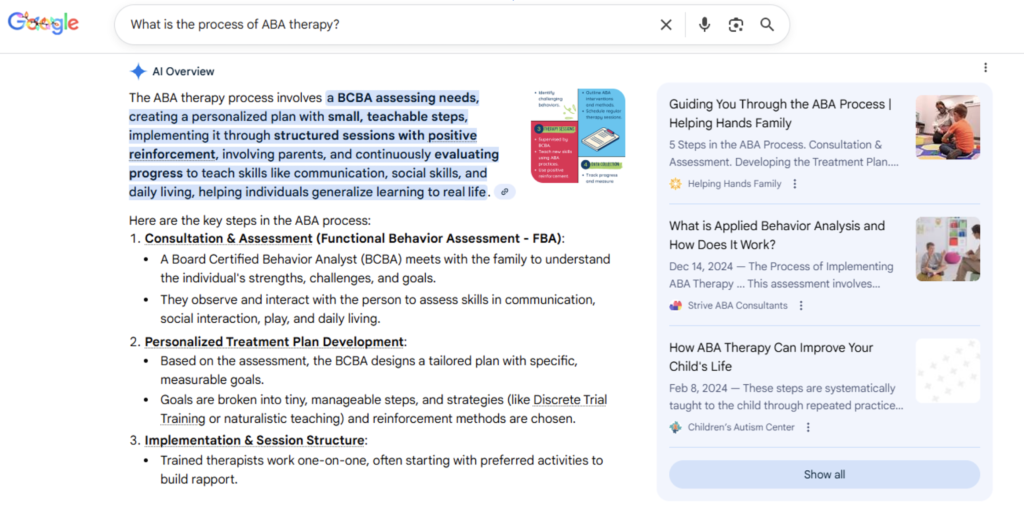
Authority signals now matter more than volume. That means:
- Strong provider bios with real depth
- Clear explanation of treatment approaches and philosophies
- Content that shows clinical understanding, not surface-level definitions
Behavioral health patients are especially sensitive to trust cues. When someone already feels unsure or vulnerable, the difference between a general article and something written with clear expertise is enormous. Make your digital presence feel like a direct extension of your clinical team, not a content factory.
3. You’re marketing to more than one decision-maker
In behavioral health, decisions almost never happen in isolation. Parents, partners, friends, and sometimes employers participate in choosing a provider. Yet most marketing still speaks only to the patient.
Think more broadly about the decision-making unit. A parent researching teen therapy is looking for safety, communication, and family involvement. A spouse supporting someone in recovery wants clarity and stability. Referral partners want reliability and access.
This is where diversified channels help. Meta, YouTube, and upper-funnel video reach these supporting voices far earlier in the journey, long before they’re typing terms into search.
Create resources for each of these audiences and invite them into the journey. Your digital front door should welcome everyone involved.
4. Staffing shortages make capacity your new guardrail
Workforce scarcity continues to shape behavioral health. Limited provider availability affects how many patients an organization can realistically serve. According to the ATMC 2025 Behavioral Health Trend Report, 56% of organizations cite recruitment and staffing shortages as a top challenge. This creates a ceiling on how much patient volume you can actually absorb—yet many organizations don’t align their marketing with their operational reality.
Capacity visibility should be considered part of your marketing infrastructure. A simple structure helps:
- Tier 1 (Green): Open capacity, ready for patient growth → Full media investment
- Tier 2 (Yellow): Near capacity, targeted investment → Retargeting and organic content only
- Tier 3 (Red): Overbooked or staffing constraints → Media paused
When that framework is paired with regular alignment with operations, marketing becomes far more efficient. Redirecting spend to green locations increases booked appointments and lowers acquisition costs. This also protects your brand by reducing the number of patients who feel stuck or ignored in the process.
Organizations that adopt capacity-aligned marketing often see material improvements in booked appointments and cost-per-acquisition. In behavioral health—where wait times can be critical—this alignment also protects your brand.
5. Patient trust is slipping
Public trust in institutions is down across the board, and healthcare isn’t exempt. Behavioral health carries an added layer: the emotional risk of seeking care as patients are often navigating stigma, fear, or previous negative experiences.
Authenticity is one of the most effective trust builders right now. Patients want to hear from real clinicians and real people. They want to see the environment where they’ll receive care. They want plain language, not clinical jargon.
Strengthen trust by incorporating:
- Provider interviews and treatment philosophies
- Patient stories shared with intention and permission
- Educational content that breaks down complex ideas in simple language
- Behind-the-scenes looks at programs and care environments
Above all, avoid clinical jargon in patient-facing materials. Small shifts like writing at a sixth-grade reading level or explaining acronyms make a noticeable difference in how trustworthy you feel.
6. ROI measurement is the baseline
A growing number of behavioral health organizations report uncertainty about which channels produce the strongest results. Leadership teams want clarity. They want to understand how marketing contributes to patient volume and revenue.
To meet this expectation, invest in foundational measurement capabilities:
- Call tracking that connects campaigns to scheduled appointments
- Data integration across your CRM, ad platforms, analytics, and scheduling systems
- Dashboards that show spend, booked appointments, cost-per-acquisition, and revenue
Advanced measurement approaches—incrementality tests, media mix modeling, and causal attribution—become reliable once your data is unified. These tools clarify which channels scale efficiently and where diminishing returns begin.
Monu Kalsi, SVP of Marketing at Duly Health and Care, put the responsibility bluntly at Scaling Up:
“Own a number or numbers. Make sure you understand how you directly or indirectly influence or drive that metric… You have to connect those dots in order to keep your job.”
It’s the clearest reflection of where expectations now sit for healthcare marketing leaders.
7. The paid search ceiling is real
Many behavioral health organizations invest most of their budget in search because it’s direct and trackable. But search captures demand; it doesn’t create it. As more competitors enter the channel, costs continue rising.
As Matt Stringer, CMO of Action Behavior Centers, shared at Scaling Up 2025:
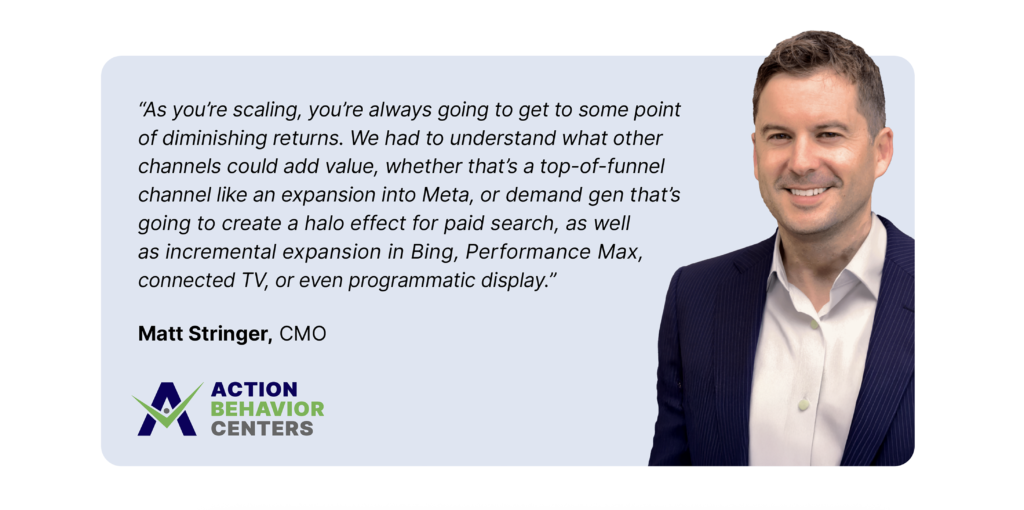
The takeaway is clear: search works best when supported by channels that build earlier awareness and shape the decision long before someone types a query. Here’s how to build a diversified media mix in 2026:
- Conduct a baseline assessment of your current channel mix. If search is >70% of the budget, you’re likely leaving growth on the table.
- Test 1–2 new channels with structured experiments tied to patient volume outcomes:
- Meta (Facebook/Instagram): Reach patients and decision-makers with storytelling at scale. Ideal for behavioral health because you can target by interests and life events (family challenges, relationship issues, mental health interests)
- YouTube: Share educational content and build trust before someone needs immediate care
- Connected TV (CTV): Reach premium audiences with video content (higher cost, but strong brand-building effect)
- Programmatic display: Retarget website visitors and reach relevant audiences across the web
- Allocate 20–30% of the budget to upper-funnel awareness channels and measure their halo effect on search performance
- Set clear success metrics for each channel and hold them accountable to patient volume outcomes, not just engagement metrics.
The DMU complexity we mentioned earlier makes diversification even more critical. You need channels that reach parents, partners, and referral sources who aren’t actively searching. Meta and YouTube excel at this.
8. Messaging must be simple to be effective
Behavioral health is filled with terms that make sense to clinicians but leave families confused. Acronyms like IOP, PHP, DBT, and EMDR are meaningful only when explained clearly.
User testing helps identify where language causes friction. Simplifying terminology improves comprehension, reduces anxiety, and supports informed decision-making.
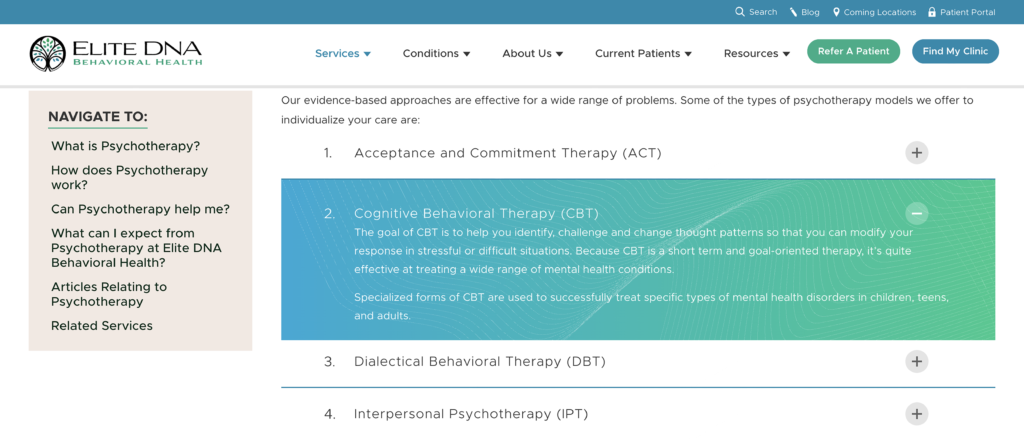
Helpful tactics include:
- A glossary that explains clinical terms in plain language
- Program descriptions that describe the day-to-day experience rather than methodology
- Infographics or short videos that illustrate the treatment structure
Instead of “PHP involves intensive outpatient care focused on bio-psychosocial interventions,” try: “Our day program gives you intensive treatment during the day, so you can sleep at home at night. Most people come 5 days a week.”
Small adjustments in clarity often have a measurable effect on engagement and conversion.
9. Operationally readiness can’t be ignored
Marketing teams often feel intense pressure from the C-suite to move quickly. Leadership wants to see new patient volume and immediate traction for new programs or providers. Campaigns get requested before anyone has confirmed whether the site has appropriate staffing levels, scheduling availability, or intake coverage. In behavioral health, that friction shows up where it matters most: in the first contact a patient or family member has with your organization.
A pre-launch readiness checklist helps ensure alignment across teams. Confirm that:
- The campaign supports a defined growth goal
- Scheduling and staffing can absorb the expected volume
- Admissions or call center teams know what to expect
- Systems and workflows are updated
- The definition of a qualified lead is shared and understood
When behavioral health patients take the step to reach out, the first interaction matters. Operational readiness protects both patient experience and marketing efficiency.
10. Strong marketing + operations partnerships drive results
High-performing behavioral health organizations are building deeper alignment across teams. When marketing and operations share a unified view of capacity, patient volume, and campaign timing, decision-making becomes faster and more reliable.

Consistent cross-functional meetings, shared dashboards, and clear rules for scaling or pausing campaigns help teams stay connected. This alignment not only reduces waste but also supports more predictable growth.
A single view of the truth—capacity, media, performance—gives both teams the confidence to act decisively.
The bottom line: efficiency and clarity define 2026
Behavioral health marketing in 2026 is defined by clarity, efficiency, and strong partnerships across the organization. The teams that make the most progress will:
- Focus on their unique strengths
- Build authority through expertise
- Diversify beyond search
- Strengthen trust through transparency
- Align marketing and operations around patient volume and capacity
The opportunity isn’t in doing more. It’s in doing the right things with more intention, more coordination, and more clarity. When you combine that with a strong understanding of your data, you can build a marketing engine that supports growth and delivers meaningful care.
