




Every month, my team runs more than 50,000 patient prompts through eight AI engines and records which healthcare brands come back in the answers. We track about 200 organizations this way, from health systems to specialty groups to multi-location brands. The brands AI names most often share one trait. Their own website is one of the top two sources AI cites in their category.
Table of Contents
That matters because of how your patients search now. About 1 in 3 U.S. adults uses AI for health information [KFF, March 2026]. Google fields more than a billion health questions a day, and those searches have grown three times longer as people describe their whole situation [Google, March 2026]. The AI answers with a short list of names.
Valerie Stover, senior manager of organic growth and community at Affordable Care, described the marketer’s side of that moment on a Scaling Up panel this fall:
“The shortlist is getting made without anyone ever reaching our website, and the decision gets made, and we’re not in the room, and we don’t even know we got rejected.”
So how do you get on that list? After a year of tracking, testing, and about 100 audits, my answer comes down to three moves. You own the source. You pick a fight you can win. Then you grow from strength, one funnel stage, market, or service line at a time. Below you’ll find the data behind each move, the client results that back it up, and a 90-day plan to get started.
What our data shows
Most healthcare marketers I talk to can’t say whether their brand shows up in AI answers, why it does or doesn’t, or what it would take to change that. My team set out to answer those questions with data. Over the past year, we built a tracking program just for healthcare, and we run it every month. Every prompt is a healthcare prompt, and every brand is a healthcare brand like yours.
Here’s how we built the dataset:
- ~200 healthcare organizations, including health systems, specialty groups, and multi-location brands
- 50,000+ patient prompts, built by service line, city, brand vs. generic, and funnel stage
- 8 AI engines, including ChatGPT, Gemini, Perplexity, AI Mode, and Google AI Overviews
- Monthly re-runs and comparisons
- Visibility is the share of prompts where a brand appears, and position is its average rank within the answer, where lower is better
After a year of tracking, three findings stand out.
The most visible brands are their own top sources
Look at the brands AI names most, and you’ll find their own websites near the top of the citation list.
- 39.6% average visibility for the 9 clients whose own site earns 5% or more of AI citations
- 5.2% average visibility for the 7 clients whose sites miss the top 25 cited sources
- Every client above 30% visibility has its own site as the #1 or #2 cited source
Google sits in the middle of all of it. google.com is a top-25 cited source in 22 of 23 categories and the #1 source in 10, including every dental client we track. Is SEO dead? Of course not. The work that feeds Google feeds the AI answers too.
Reddit gets a lot of hype, but the data suggests it matters less than people claim. It’s a top-10 source in only 4 of 23 categories and never tops 2.1% of citations. Healthcare runs on trust, and anyone can write anything on Reddit with zero prerequisites.
So tell the story you want AI to repeat, because nobody talks about your brand more than you do.
Each engine picks its own winners
Just because your brand performs well on ChatGPT doesn’t mean you’ll see the same results on Gemini or Google’s AI Overviews. Each engine relies on different sources and produces different recommendations, so the brands that dominate one platform aren’t necessarily leading on another. Our data shows just how much visibility can vary.
- 13 of 23 categories have a different #1 brand depending on the engine
- 5 of 23 categories have the same leader everywhere
- 2.2x is how much stronger the typical client is on its best engine compared to its worst
At the extremes, a brand can sit near 100% visibility on ChatGPT and barely register on Perplexity or Claude. Strong brands usually hold a top-three spot across engines, and the order still shuffles.
The engines trust different sources, too. In healthcare, ChatGPT pulls 27% of its citations from government sites and just 1% from elite hospital systems. Google AI Overviews flips that, with 33% from elite hospital systems and 10% from government sites [source].
Do you need to win all eight? No. Perplexity is healthcare’s weakest engine, with clients averaging 20.4% visibility there compared to 27.2% on Gemini. With finite resources, I’d focus on Google’s AI surfaces and ChatGPT. I also expect this market to settle on one or two winning platforms, so keep watching where your patients go.
Leaders pull away, and the pack stays close
AI visibility isn’t distributed evenly across healthcare brands. In most categories we track, there’s a clear leader that shows up far more often than everyone else. Behind that leader, the competition is often much closer. That creates an opportunity for brands that aren’t sitting at #1 today.
- 15.6 points is the median lead over #2 in the 11 categories where our client is #1
- 9.9x, 4.2x, and 3.8x are how far three of those clients lead the next brand
- 5.3 points is the median gap in categories where someone else is #1
- Under 3 points separates the leader from the next brand in 5 categories
I read this as a compounding advantage. Whoever reaches #1 builds momentum, and AI keeps citing them. Behind that leader, the race is tight, which means moving into the top three to five is often a more realistic first goal. The longer you wait, the harder it may become to close the gap.
Three moves that earn AI visibility
Everything we’ve tracked and every client program we’ve run points to the same three moves. Each one comes with proof from the field, including two stories where things went wrong.
Move 1: Own the source
AI leans hardest on your own website, so that’s where your proof needs to live. Your providers, outcomes, credentials, and research all belong on your domain, tied clearly to your brand. AI is terrified of being wrong, and won’t recommend you if the data conflicts. Give it one consistent, well-supported version of your story, and it will repeat it.
When your best proof lives somewhere else
I came across a brand during an audit that had just about everything a healthcare marketer could ask for: a 95%+ clinical success rate, a patented approach, research studies, and compelling provider stories.
On paper, it had an incredible story to tell. But AI barely knew it existed.
The brand appeared in just 0.4% of AI answers, ranking #175 in its category. Meanwhile, the category leader had 35% visibility.
So what was going wrong?
The proof was there. It just wasn’t where AI could easily connect it to the brand. Research and provider stories lived on other websites. The brand’s own site offered shallow summaries and links to that information, without a central hub connecting its providers, credentials, outcomes, and approach.
This is something I see more often than you’d think. Healthcare organizations invest years building expertise and delivering great care, but don’t do enough to communicate that value on their own websites.
The opportunity here is to bring that proof home. Build a central hub around the program, connect the providers and research to the brand, and answer the questions patients actually have. What are my alternatives? How much does it cost? What does that success rate mean for someone like me?
A five-star review or a great quote isn’t enough anymore. If you have an incredible story to tell, make sure your website tells it.
Make sure AI gets your story right
AI repeats what it reads, and you’d be surprised how often my audits surface inaccurate or conflicting information. When AI finds two versions of the truth, it hesitates to recommend either one. If individual providers in your group run personal websites, that’s okay. Put the same bios, credentials, research, and stories on their provider pages on your site so the trust they earn builds your entity too.
Don’t overlook local search
Google has split healthcare search into two lanes:
- 89% of healthcare keywords now show AI Overviews, including 100% of treatment queries and 93% of symptom queries
- 0% of “near me” provider searches show AI Overviews, down from 100%, and those searches now go to the map pack
For a multi-site brand, your website feeds the clinical answers and your listings feed the map pack. Your provider and location details need to match across both.
Move 2: Pick a fight you can win
AI got personal this year. ChatGPT Health launched for U.S. users on July 23, allowing people to connect medical records from Epic, Oracle Health, Apple Health, and One Medical. Amazon brought its health AI to Amazon.com, and Google added medical records to Fitbit’s health coach. AI now answers in the context of each patient’s own history, which means it rewards brands with something specific to say. Generic content has to compete with everyone.
Todd Richards, senior director of digital marketing at Keck Medicine of USC, put it this way at Scaling Up:
“We think about differentiation, not so much worried about things like, what’s the definition of sarcoma… we focus on how we might be better at, and different at, treating that sarcoma.”
Specificity also gives you a way in when you’re not the big dog. AI almost never hands a patient one name unless the market is rural. Ask for pediatric care in your area, and you’ll get several options. So your first goal is to get into the consideration set, the top three to five brands. Reaching #1 takes time, budget, and a clear value proposition. Getting onto the shortlist is where you start.
Win the questions that matter most
We could have gone after the big, generic searches. Things like “I’m hurt, do I need a doctor?” But those questions put the brand up against massive healthcare publishers and national health systems. It’s tough competition, and not necessarily the best use of a limited budget.
So we got specific.
Instead of trying to answer every injury-related question, we focused on the higher-consideration decisions patients make after an injury, where the client had real clinical expertise and services to offer:
- Imaging: Do I need an MRI or X-ray? Where can I get one?
- Physical therapy and rehab: What are my treatment and recovery options?
- Pain management: Where can I get help managing ongoing pain?
Then we trimmed the fat. We removed generic content that diluted what the client does best. Deleting content can be surprisingly effective, because noise makes it harder for AI, and for patients, to see what makes you different.
From July to September:
- PT and rehab grew from 1.7% to 22.0% visibility
- Pain management grew from 2.7% to 20.8%
- Imaging grew from 11.6% to 21.4%
- Generic advice slipped from 2.6% to 1.7%, a deliberate choice to stop investing there
Today, the client is #1 in its category at 22.6% visibility, 2.6x the next brand. The lesson? You don’t have to answer every healthcare question to win in AI search. Find the questions where your brand has something valuable to offer, build authority there, and let the results guide your next move.
Find the gaps your competitors aren’t owning
Everyone wants to be #1. I get it. But what happens when your competition includes Ro, Hims, Amazon, and pharmaceutical companies with massive budgets and national advertising campaigns?
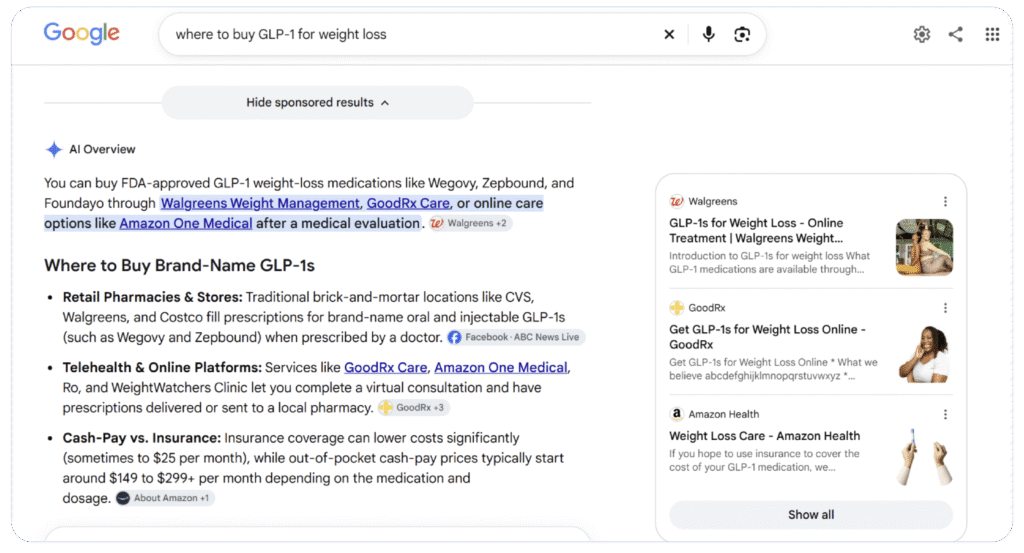
That’s the challenge facing brands entering the GLP-1 weight-loss market.
One brand I audited was trying to compete directly with those established players for the most popular GLP-1 questions. Unfortunately, the numbers were moving in the wrong direction.
From April to September, the brand fell from #5 to #33, with visibility dropping from 13.3% to 2.2%. Ro, meanwhile, held steady near 29%.
The biggest declines came from the very topics where competition was most intense:
- Mounjaro dropped from 16.6% to 1.4%
- Ozempic dropped from 11.2% to 1.0%
- General GLP-1 dropped from 23.6% to 3.5%
Entrenched leaders know their position, and they’re committed to keeping it. They can see every push you make and counter it. Charging straight at them is running into a brick wall.
The data showed a better opening. On maintenance and ongoing use, Ro and Hims don’t even appear in the top six. The leader holds 17.9%, #2 holds 6.8%, and this brand sits at 2.7%. Nobody dominates that space yet.
You have two ways in against a giant. Find a gap in demand where patients are searching and nobody owns the answer. Or find what’s truly unique about your brand and hammer that wedge into the market. Either way, match your goal to your resources, and set expectations with leadership early so you don’t get your wings clipped. Organic takes time, and with this much change in the market, now is one of the best times to start.
Move 3: Grow from strength
Once you have a core you can defend, grow out from it one step at a time: up the funnel, into new markets, and across specialties. I’ve seen it time and time again. Focus on what you do best, and you’ll make a lot more hay with every dollar you invest.
Build authority before expanding your reach
When we started working with this client, the ambition was to win across the entire patient journey. From early questions about symptoms and testing to patients ready to book care, we wanted the brand to show up everywhere.
And we were making progress. Just not very quickly.
The biggest challenge was at the top of the funnel. Broad questions like “Do I need care?” or “How do I get tested?” attract all kinds of competitors, from national health publishers to providers offering alternative treatments. We were spreading our efforts across a very crowded space.
So we changed the strategy.
Rather than trying to win the whole funnel at once, we concentrated on patients who were closer to booking care. For more than a year, we invested in the content, clinical proof, and brand authority needed to win those searches.
It paid off. Now, the client owns its ready-to-book searches:
- 63–98% visibility in its core metros
- #1 overall at 59.7%
- 3.5x the visibility of the next brand
With the foundation in place, we then moved up the funnel, and progress came fast.
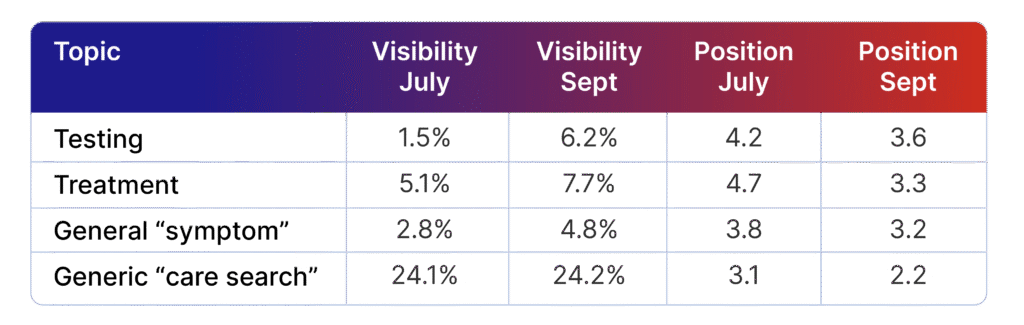
In two months, we made more progress on early-journey topics than we had in nearly six months at the start. Testing visibility grew fourfold in a high-volume, crowded part of the funnel. Generic care search held steady in visibility and climbed nearly a full position, and every topic moved up.
Symptom and treatment pages matter, and they work when a strong core stands behind them. Citation strength is becoming what backlinks used to be, and you build it at the core of what your business does.
Your national reputation won’t win every local market
The next two stories are bets we’re placing with clients right now. The results aren’t in yet, and I’ll share them when they are.
National brands ask me some version of this all the time: “Rob, how is Dr. So-and-so beating us in this market? He’s one provider at one location. We’re a national brand.”
The answer is that Dr. So-and-so is invested in his community. His whole website is stories, outcomes, providers, and nurses tied to the people he serves. That’s powerful in AI, because each patient is choosing one doctor. As a parent, I don’t care if there are 400 pediatricians in your network. My kids are only going to see one, and I want to know about that one.
One of our clients, a multi-state specialty brand, is #1 in its core market:
- 28–37% visibility on its core services
- 2.7x the visibility of the next brand
In a new market, the same service starts at about 1/20th of that visibility, and focused local specialists lead. We’ve seen national brands land 15th, 16th, or 17th when they enter a new market. Stories about doctors and patients hundreds of miles away won’t crack that shell.
Our bet is to treat each new location as its own entity, with a hyperlocal program built on the brand’s core service authority. That means local pages, provider and outcome content, case stories, and real community involvement, all mapped to the geography. It cuts against the centralized strategy many leadership teams prefer, and it’s where AI is taking local search.
Win one specialty before tackling the next
There’s more than one way to be a top visible organization. This health system client dominates its market at the system level and trails its main competitor on all five specialties below.
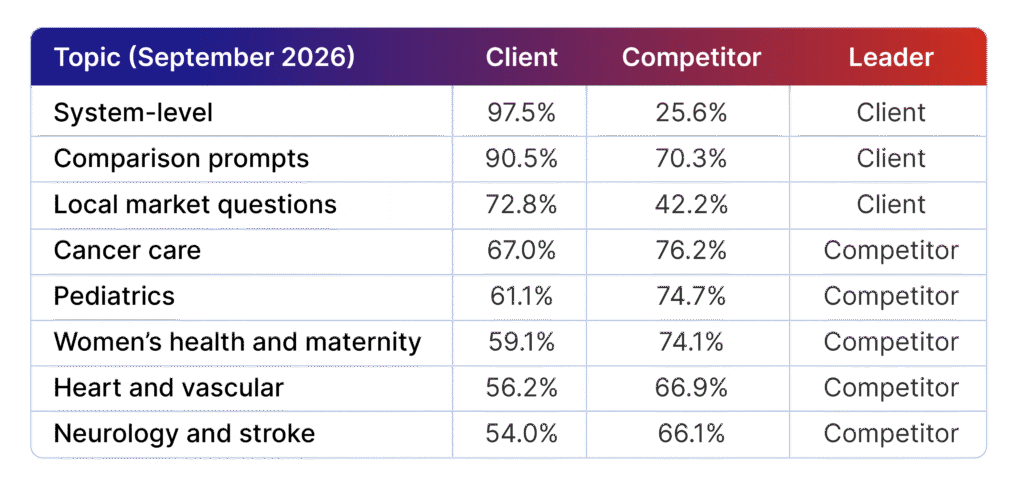
Most of those specialty gaps widened from June to September.
We’ve run the opposite play before. At last year’s Scaling Up, we shared a case where our client conceded the core and won by dominating categories. This time, we’re defending the system lead and going after the specialties.
We’re starting with one specialty, chosen because the business is strong there, has compelling stories to tell, and sees a real competitive opening. Our tracking shows which pages the competitor gets cited for, what stories it tells, and which prompts it wins, so we know exactly where to push. Once it works, we’ll turn it into a playbook for the next specialty.
A 90-day plan to start earning AI visibility
The three moves give you the strategy. This plan turns them into work your team can start this quarter. The first 30 days show you where you stand, the next 30 fix the structure AI relies on, and the last 30 put your resources behind one lane. It’s the same sequence I walk our clients through.
Days 1–30: Benchmark where you stand
Before you start making changes, get a clear picture of how AI sees your brand, where competitors are winning, and which opportunities are worth pursuing.
- Run your top 20–30 patient prompts across ChatGPT, Gemini, Perplexity, AI Mode, and AI Overviews to find your rung on the ladder.
- Test specific versions of each prompt. A national PT brand can rank 4th for “best physical therapy” and 1st for “best sports physical therapy.”
- Ask the AI why it didn’t recommend you, and ask it to compare you with your competitors.
- Track brand mentions and citations separately, and test sentiment.
- Pull the sources AI cites for your competitors. If you’re not #1, you can reverse engineer the brand that is.
Days 31–60: Fix the structure
Make sure AI can find and understand the information that makes your organization credible. That starts with your website, provider information, and location listings.
- Add organization schema and clean up your listings.
- Audit provider and location details for consistency across your site and listings.
- Correct anything inaccurate, because AI repeats what it reads.
- Bring provider content onto your domain, even if your providers keep their own sites.
Days 61–90: Pick a lane
Choose one opportunity where you have a real chance to compete. Build authority around it, support it with credible content, and give your strategy time to work.
- Choose one service line or one narrow question.
- Build depth there with content backed by real care, stories, and proof.
- Earn mentions from the third-party sources AI already cites in that space.
- Trim the generic content that dilutes your focus.
Every month after
AI answers change constantly. Keep tracking your priority prompts, watch what competitors are doing, and use those findings to decide where to invest next.
- Re-run your prompts and compare. AI answers shift constantly, so judge your progress by the trend across months.
Build before the shortlist gets crowded
Remember that shortlist we talked about at the beginning? Patients are already using AI to decide which healthcare providers to consider, often before they ever visit a website. And as more brands compete for those recommendations, earning a place on that list will only get harder.
The ads are coming, too. Google is testing healthcare ads inside AI Mode in the U.S., and paid placements will introduce another layer of competition. I actually think that’s good news in the long run. Once more advertising dollars flow into these platforms, attribution will have to improve.
But I also know what healthcare marketers are up against. You’re being asked to prove the value of your investments, defend budgets, and drive patient growth, all while the search landscape keeps changing.
My advice? Be strategic about where you compete.
You don’t need to win every prompt or outrank every competitor. Understand where you stand, own the expertise that makes your organization different, and invest in the opportunities where you have a real chance to win.
The goal is to make sure that when patients are looking for the care you provide, your brand is part of the conversation.
Want to know where you stand? My team offers a free AI visibility audit. We’ll benchmark your brand against competitors across your priority prompts and major AI engines, then show you where your best opportunities are. Request your audit here.
