




It’s a new year, and healthcare organizations are setting ambitious targets. They’re defining growth goals, mapping capacity constraints, and plotting where they want to be by year’s end. For marketing teams, the challenge is clear: they’re responsible for driving much of that progress and turning those goals into reality.
But how do you bridge the gap between where you are now and where you want to be? The key is a robust digital marketing roadmap. This roadmap ensures your efforts are focused on what matters most, aligns your team around shared priorities, and keeps you on track to achieve meaningful results.
At Cardinal, we build comprehensive, integrated digital marketing roadmaps for all of our clients. These roadmaps outline exactly what you can expect at specific times and how those activities support your goals. They document where your budget is being spent each month, how each initiative contributes to your overall business objectives, and what checkpoints will be in place to evaluate progress.
In this blog, we’ll break down why a roadmap is essential, how to get everyone involved and aligned, and what key elements to include. Plus, don’t miss the free template at the bottom to get you started!
Why do I need a digital marketing roadmap?
Without a roadmap, you’re pretty much flying blind. A comprehensive marketing roadmap gives your team much-needed clarity in three key areas:
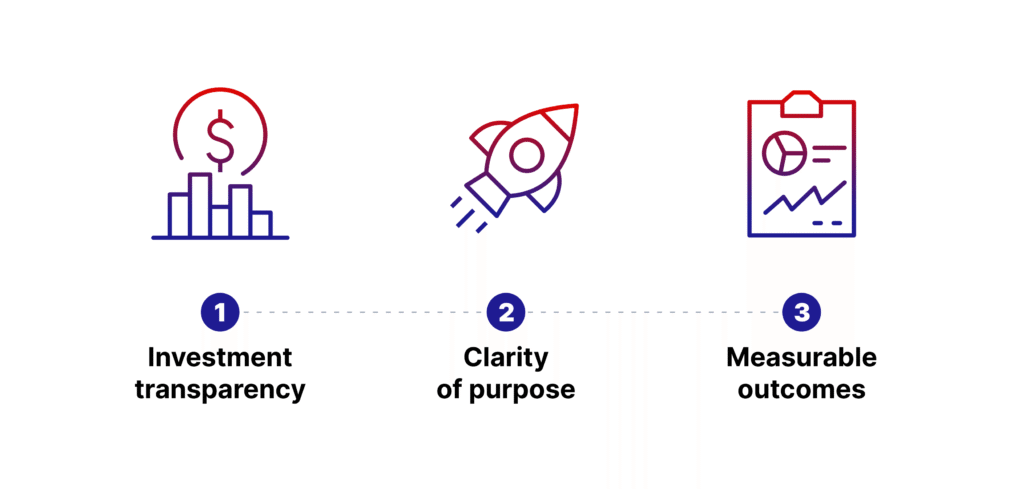
1) Investment transparency
A good marketing roadmap includes a detailed strategy showing where the budget will be spent on a month-by-month basis, so you’re not in the dark. From new search campaigns to content initiatives to your overall media mix, every strategic initiative is documented so you understand where your budget is going and why.
2) Clarity of purpose
It’s not enough to know how your budget is being spent; you also need to know why. A comprehensive marketing roadmap addresses your business objectives by explaining how each strategic initiative helps get you closer to your goal. This ensures that your team stays aligned and focused on initiatives that have the greatest impact—especially for anything that came up as a priority during your marketing audit.
3) Measurable outcomes
Perhaps the greatest benefit of a good roadmap is that it offers a timeline with specific expectations, thereby giving you a way to chart progress. With a clear timeline of goals, strategies to achieve them, tangible deliverables, and metrics for measuring success, you (and your C-suite) will be in a much better position to evaluate your marketing strategy on an ongoing basis instead of just waiting to see what happens.
“One observation about roadmaps is that you can archive things and hide the rows, and it becomes a nice place to look back on the strategic pillars over a quarter, a half of a year, a year… it becomes a ‘What did we learn?’ memory guide.”
—Lauren Leone, Chief Growth Officer, Cardinal Digital Marketing
What should a digital marketing roadmap include?
Enough specifics to accomplish the above three points.
At a bare minimum, this means:
- Objective: The business objective behind each individual item.
- Implementation: A description of the specific process and strategy you’ll be using to accomplish said objective.
- Timeline: A timeline for completion, whether that’s specific dates or quarterly milestones.
- Status: Where things stand currently.
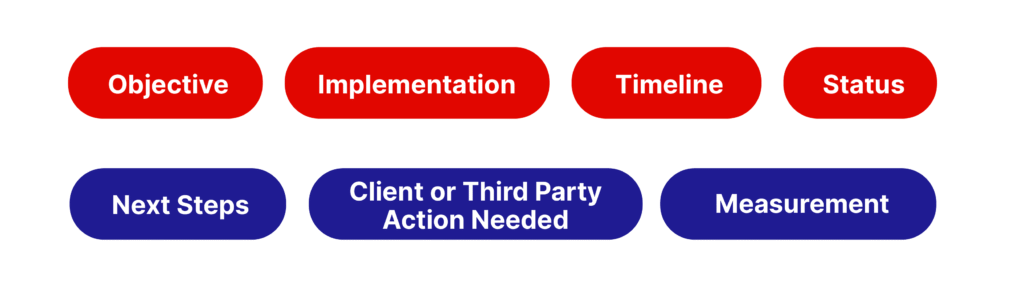
We also often find it useful to include the following:
- Next Steps: More detailed than just a status; this informs everyone of what needs to happen next.
- Client or Third Party Action Needed: You could put this under next steps, but we find it helpful to call this out specifically.
- Measurement: How will the success of this initiative be measured?
Our process for building roadmaps
At Cardinal, creating an effective roadmap is a process that involves a number of steps:
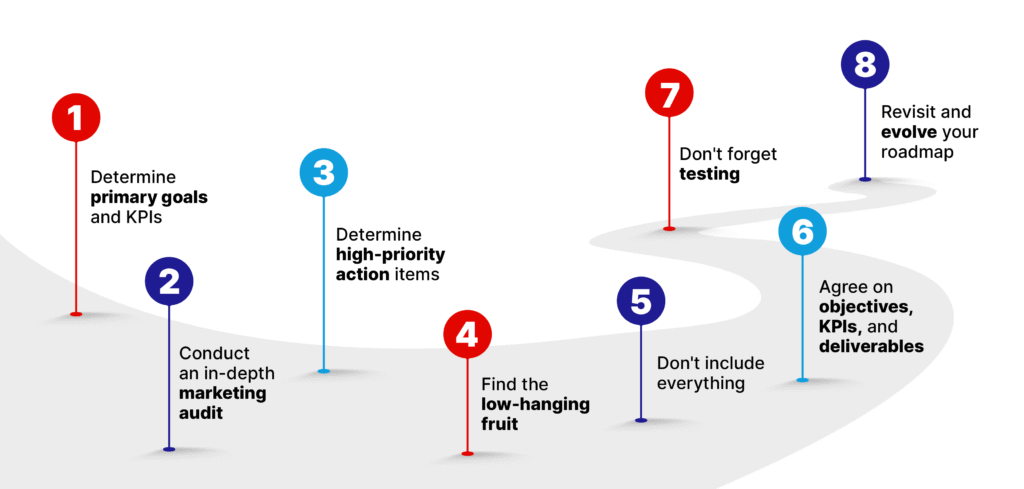
1) Determine primary goals and KPIs
Before you even look at a roadmap, the first thing to do is have a conversation to ensure you understand the larger holistic business goals as well as the specific, measurable marketing goals. Marketing can’t exist in a vacuum and must have close alignment with the C-suite and operations. This is crucial to ensure digital is helping the whole business meet its goals.
With our clients, this is a conversation we have at the beginning of our onboarding and typically in our first interaction. We often ask: Where are you on the marketing maturity curve? Are you optimizing demand capture, or are you ready to expand into demand generation? Are you early in your digital journey, or have you been investing in performance marketing for years?
2) Conduct an in-depth marketing audit
A thorough review of all current marketing helps establish a baseline to understand what’s working well and what isn’t. This covers a wide range, including:
- Ad campaign performance and channel efficiency
- Lead-to-booked appointment conversion rates (not just lead volume)
- Media mix and investment gaps
- Persona and target audience alignment
- Website technical health and user experience
- Content strategy and information gaps
- Search and AI visibility
- Data integration and analytics capability
- Martech stack completeness and integration
3) Determine high-priority action items
With limited budgets and resources, it’s essential to prioritize initiatives that will have the greatest impact on your business goals. By leveraging audit findings and a clear understanding of your goals, you can identify the highest-priority actions to include in your roadmap. For instance, your review might reveal a month-over-month decline in lead volume within a key market—highlighting an area that requires immediate attention. Or you might discover that you’re capturing leads but not passing conversion data back to your ad platforms, limiting their ability to optimize. This process ensures your marketing efforts stay focused on what matters most.
4) Find the low-hanging fruit
The best place to start your roadmap is with items that have the most potential for a high-impact to low-effort ratio. Two recent examples from Cardinal clients:
- While reviewing a client’s ad targeting, we noticed they were operating on statewide targeting even though they had a goal to drive patient volume within a specific regional market. We identified this as potential waste because targeting areas far from their locations meant reaching people who would rarely come in. We verified that the client had no reason for such broad targeting, and geographic radius targeting would be more efficient.
- When putting together an SEO roadmap for a multi-location healthcare group, our site audit revealed an opportunity for low-effort page speed improvements, on-page optimizations for low-competition keywords, mobile optimizations, and the removal of duplicate content. Compared to complex SEO tactics that take months to reach fruition, these require much less effort to resolve and translate into tangible near-term gains.
Notching some easy wins is a great way to start your roadmap to boost project confidence and build momentum.
5) Don’t include everything
Tempting as it may be to include every possible marketing improvement on your roadmap, part of making a successful roadmap is keeping it focused on the key business objectives and the biggest, most important action items. There will naturally be a number of evergreen items that you are working on—monitoring accounts, confirming performance, reporting on results, etc.—which don’t need to be included on the roadmap.
“Let’s just identify and focus on the new items we need to move the needle on, as it relates to business objectives. That would manifest in items like, if we’re supporting new clinics being launched, we need to develop the strategy and the structure for the campaigns and then deploy them. These are big ticket strategy and digital items that we want to put on and identify on the roadmap.”
—Evan Ilgenfritz, VP of Paid Media, Cardinal Digital Marketing
6) Agree on objectives, KPIs, and deliverables
Once you’ve taken into account all relevant information from business objectives to audit findings and planned out your high-priority targets and low-hanging fruit while eliminating evergreen activities, it’s time to hammer out the details of your roadmap. Keep in mind that sometimes the key performance indicators that are most initially appealing aren’t the ones with the strongest business case. Make use of the discovery phase and the audit findings to identify the most viable near-term and longer-term KPIs worth tracking.
This is also a good time to take inventory of the near- and long-term deliverables needed to support your patient acquisition strategy and make sure those are included on the roadmap. Once you have the buy-in, you don’t just need a brief to outline the plan but also KPIs and checkpoints in place to verify performance.
“Once we’ve made it through the phase of identifying a potential opportunity and then verifying through data that the client agrees with the strategy, now it’s time to roll up the sleeves and come up with a brief that really outlines what the plan is, how it functions, what the expectations are, and KPIs and all that.”
—Evan Ilgenfritz, VP of Paid Media, Cardinal Digital Marketing
7) Don’t forget testing
Testing should be included as an integral part of the roadmap, not just as an afterthought.
It’s important to use your roadmap to evaluate new channel investments in a structured way. Any major changes to your channel investments should be approached with a “Test and Learn” mindset. No matter how great you think your strategy is, you cannot be sure until you actually test it.
Testing roadmaps is essential to challenge assumptions and prove which investments will actually be effective. But in spite of this, we’ll often have new clients come in, and when we look at what their previous teams have been doing, we see no evidence of testing. So either the testing wasn’t documented, or more likely, was never done in the first place.
When it comes to new channels, a lot of your testing strategy will come down to your circumstances, marketing maturity level, and current objectives of your business. For businesses newer to the digital space, you’ll probably want to start in paid search, and in some sense, everything is a test because you’re just figuring out the space. For a more established digital program where you’re spending hundreds of thousands monthly in paid search—and have been for years—you’re probably starting to hit the ceiling of diminishing returns and want to be testing into other channels.
As you do that, you have to keep risk management in mind. That’s what testing is for: to allow you to pick a test budget that you can afford, understand the risks and the benefits, and give the new channel a fair shot. That will give you the live feedback to understand whether the results are good and you should consider expanding or whether the ROI isn’t there—which is much better to find out with a test than with a full-budget campaign launch.
“Testing is super important for everything we do. Even if it’s a really good idea, we probably want to approach it as a test first to verify, limit risk, try it, confirm it, and then roll it out. That’s the method. So, in terms of the road map, testing is one of the most important things to have on the road map to make sure that we’re doing that and driving things forward.”
—Evan Ilgenfritz, VP of Paid Media, Cardinal Digital Marketing
8) Revisit and evolve your roadmap
Here’s a critical mindset shift: your roadmap isn’t something you create once and shelve. It’s a living document that becomes part of your organization’s culture. At Cardinal, we revisit roadmaps with our clients regularly—quarterly, during business reviews, whenever priorities shift, or when results prompt a strategy pivot. These conversations aren’t about failure; they’re about learning.
When you gather your team around the roadmap to check progress, you’re doing more than reviewing metrics. You’re acknowledging what worked, questioning what didn’t, and staying flexible enough to adapt. Did a channel underperform? Move that budget. Did you uncover a new patient acquisition opportunity? Add it to the next quarter. This is how roadmaps become strategic tools instead of static documents.
Your roadmap also becomes a bridge between marketing and the rest of your organization. Operations needs to understand capacity constraints and patient pipeline goals. Finance needs visibility into media spend and ROI expectations. Clinical leadership needs to know how marketing efforts support growth targets. A shared roadmap keeps everyone speaking the same language and working toward the same objectives. It transforms “marketing’s plan” into “our plan.”
The teams that win are the ones that treat their roadmap as a cultural anchor—something that gives direction, allows flexibility, and brings clarity when priorities feel muddled.
Integrated marketing roadmaps: A template for success
A comprehensive roadmap ensures that your teams are aligned, with a clear understanding of what is being done and why, and a timeline that lets stakeholders track progress and business impact.
But beyond the benefit to teams, a good roadmap also benefits your marketing by focusing your efforts on high-priority or low-hanging fruit, delivering tangible results that improve your short- and long-term marketing health. Roadmaps also provide a way to define and measure these benefits with agreed-upon KPIs.
Roadmaps also lay a solid foundation for future strategy development by ensuring your marketing strategy is organized and prioritized. Perhaps most importantly, creating a formalized and comprehensive document that makes your marketing strategy transparent to all stakeholders (with metrics for evaluation) fosters accountability from everyone involved.
If that sounds like something you’d benefit from, download our free Marketing Roadmap Template, and you can start building your own roadmap today. If you’d like some expert assistance with a comprehensive marketing audit to better understand your business needs, don’t hesitate to drop us a line.
