




Building a strong measurement foundation takes time. And over the last four years of Scaling Up, we’ve had a front-row seat to healthcare marketers doing exactly that.
I think back to our first summit, when healthcare marketers were still reeling from the uncertainty surrounding the U.S. Department of Health and Human Services (HHS) Office for Civil Rights (OCR) tracking technology guidance. Organizations were pulling tracking pixels, scrambling to rethink their tech stacks, and trying to figure out how they could measure marketing performance while staying compliant.
For an industry already behind in marketing measurement, it was a wake-up call.
Over the next several years, marketers shared their progress with us. They secured buy-in for customer data platforms (CDPs), implemented call tracking, connected marketing data to patient appointments, and built closer relationships with operations.
What stood out to me at Scaling Up 2026 was how much those conversations have changed. Several speakers returned to our stage with stories about what they can now do with the foundations they’ve spent years building. They’re forecasting patient growth, proving the value of advertising, and making smarter investment decisions.
That’s why I’ve been calling 2027 the year of the decision.
After years of building the infrastructure, healthcare marketers are finally getting the data they need. AI is making that information easier and faster to analyze. The next opportunity is turning those insights into decisions that grow patient volume.
Here are the conversations and takeaways from Scaling Up 2026 that stood out to me:
The measurement foundation is finally paying off
We talk a lot about connecting marketing investments to patient acquisition. At Scaling Up, we saw how organizations are putting that information to work.
Action Behavior Centers: From better attribution to smarter growth
Last year, Matt Stringer, Chief Marketing Officer at Action Behavior Centers (ABC), shared how his team was building its measurement infrastructure. This year, Amy Welsh, VP of Marketing Analytics at ABC, returned to show what that investment has enabled.
Implementing call tracking helped ABC understand where families were coming from, replacing a large volume of leads previously attributed to “other.” But the insights went further. The team began making neighborhood-level investment decisions, using call recordings to improve messaging and staff training, and feeding qualified calls back into advertising platforms.
I love seeing that progression. ABC has gone from figuring out where leads originate to identifying where its next wave of growth might come from.
Turning a budget conversation into a patient growth forecast
Cardinal’s Alex Kemp, Senior Director of Analytics, and Scott Cameron, Group Media Director, shared another example of how better measurement changes the conversation with leadership.
Their client had room to grow but needed a reliable answer: How much more should we invest, and how many additional patients can we expect?
With two years of clean, HIPAA-compliant booking and lead data, the team developed four investment scenarios showing projected bookings, cost per booking, and recommended channel allocations.
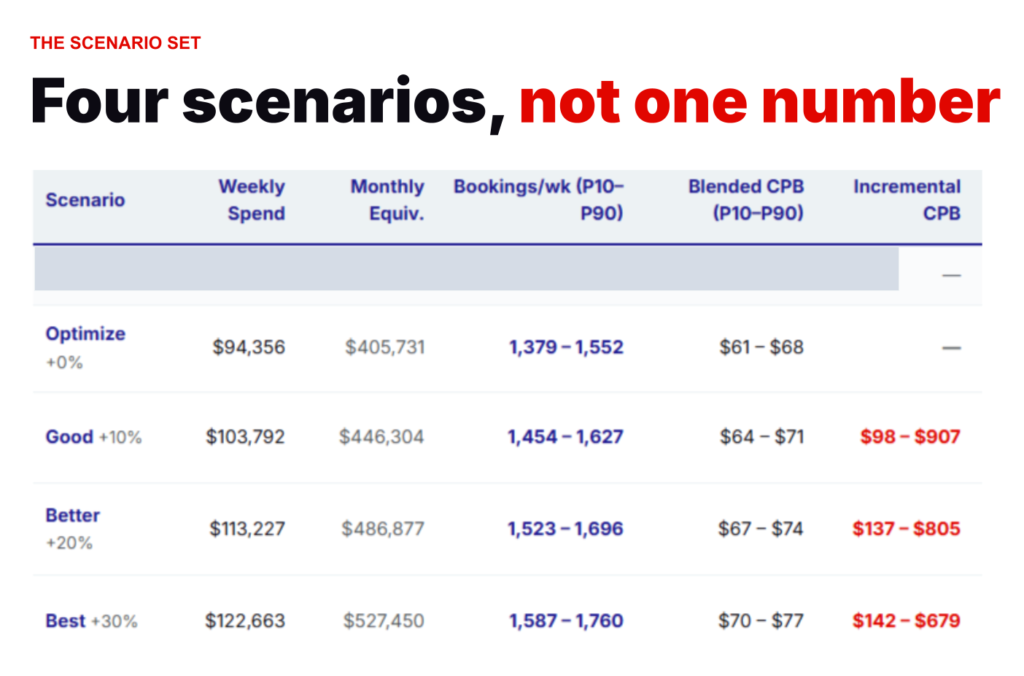
The client approved a budget near the top of the four scenarios. New patient bookings increased by approximately 16,000 year over year, while cost per booking stayed below target. Further refinement reduced forecast error from 16% to 4.5%.
A budget conversation sounds a lot different when you can show leadership the expected return, explain the tradeoffs, and adjust forecasts as conditions change.
That’s the kind of progress we’ve been working toward.
AI is changing how patients find care and how marketers reach them
If you’ve been on the healthcare marketing conference circuit lately, you know AI is on just about every agenda. Scaling Up was no exception (sorry, not sorry). We even had an AI version of me open the event.
What stood out this year was how much more sophisticated the conversation has become. From patient discovery to advertising platforms and day-to-day workflows, we’re seeing AI put to work in increasingly practical ways.
Earning visibility as the patient journey evolves
Patients are researching symptoms, comparing providers, and asking AI tools for recommendations, often before they ever reach a provider’s website.
As Valerie Stover of Affordable Care put it, “The shortlist is getting made without anyone ever reaching our website.”
Theresa Porcaro of Pelvic Rehabilitation Medicine raised another important question: “What do you type into Google when you don’t know what’s wrong?” Her team is thinking about symptoms before search terms, using call center conversations, social comments, and trusted patient and provider voices to reach people earlier in their journey.
That shift makes authoritative content even more important. Cleveland Clinic’s Amanda Todorovich made it clear her team isn’t slowing down its content investment. They’re focused on answering the questions patients are asking, wherever that research happens.
Our own research reinforces why those investments matter. Cardinal’s Rob Sauter shared findings from more than 50,000 AI prompts across eight engines, including:
- Your website still matters. Organizations whose websites earned at least 5% of AI citations averaged 39.6% visibility, compared with 5.2% for those whose sites weren’t among the top 25 cited sources.
- Visibility varies by platform. The #1 brand changed across AI engines in 13 of 23 categories.
- Early leaders are pulling ahead. Where a client ranked #1, it led the next brand by a median of 15.6 percentage points.
The takeaway for healthcare marketers? Put yourself in the patient’s shoes. Understand the questions they’re asking before they’re ready to book, create trustworthy content that answers them, and pay attention to how your organization appears across AI platforms.
Google and Meta are asking marketers to work differently
We also heard directly from Google and Meta about how AI is changing their advertising platforms. Clare Tuck and Emily Brill at Meta shared four recommendations for healthcare advertisers:
- Diversify creative. Build a portfolio of 10 or more assets per ad set, with different messages, formats, and audience angles.
- Feature real people. Bring clinicians, patients, and creators into your storytelling where appropriate.
- Test broader targeting. Give Meta’s AI room to find relevant audiences while maintaining necessary controls.
- Measure incremental growth. Establish a conversion lift baseline before scaling upper-funnel investments.
Jonathan McGowan of Google described AI Max and Performance Max as foundational capabilities for the future of Search, emphasizing appropriate controls and compliance.
As these platforms automate more bidding, targeting, and placements, the conversion signals we feed them become increasingly important.
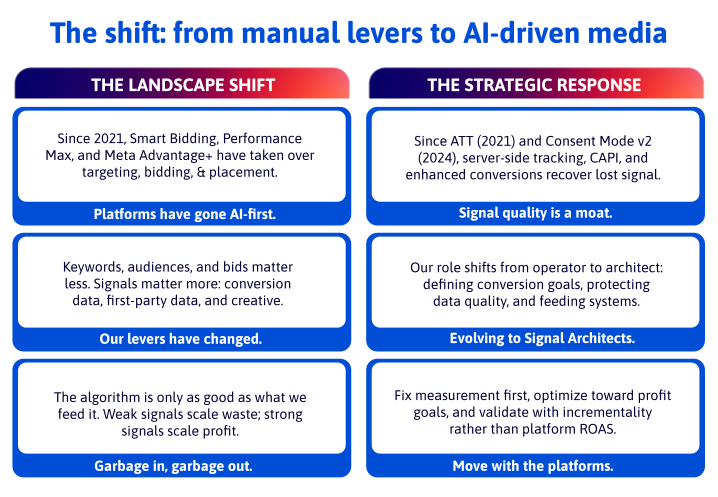
Cardinal’s Ruchi Patel put it well: “The platforms bring the AI, and we bring the signals.”
If you’ve been following Cardinal for a while, you’ve heard us talk about conversion signals. A lot. And we’re not stopping anytime soon.
Ruchi took attendees through her playbook for building a mature conversion signal strategy, from capturing the right data and prioritizing high-value patient actions to making progress when your measurement infrastructure isn’t quite where you want it to be.
As AI takes over more of the optimization, the quality of the signals we feed these platforms becomes one of the most important levers marketers can control.
AI is also changing how marketing teams operate
Some of my favorite AI examples came from marketers sharing how their teams use it day to day.
Amanda Todorovich’s team at Cleveland Clinic is working with roughly 65 custom GPTs, agents, and automations. Britney Long, Executive Vice President of Marketing at GPS Dental, shared how automating data collection has freed her team to spend more time interpreting information and making decisions.
Across sessions, we heard about marketers using AI to research audiences, analyze performance, and work through strategic problems.
We’re exploring those same possibilities at Cardinal.
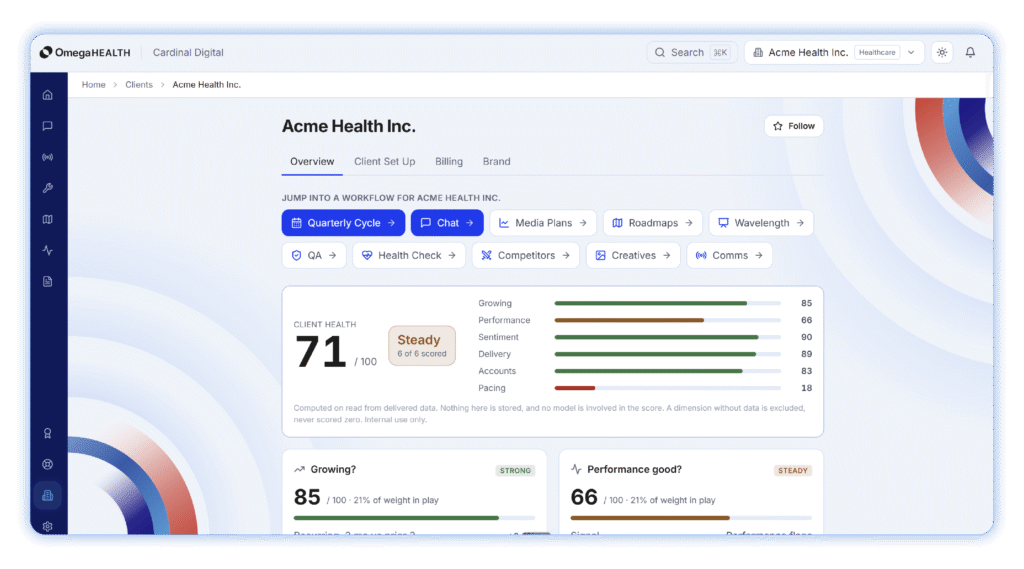
At Scaling Up, we introduced OmegaHealth, our AI healthcare growth operating system, built to help healthcare organizations understand what’s driving patient acquisition and make better investment decisions.
OmegaHealth brings together the context behind an organization’s growth strategy, including its goals, marketing performance, media plans, audits, and our team’s expertise. It can answer performance questions and recommend where to focus next, with human oversight of proposed changes.
What excites me most is how it makes sophisticated data analysis more accessible, so teams can spend less time pulling together data from different sources and more time acting on insights.
As we head into the year of the decision, that combination of AI, trustworthy data, and human expertise is becoming increasingly valuable.
Don’t lose sight of the patient experience
For all the conversations about measurement and AI, some of the most memorable sessions focused on something very familiar: making it easier for patients to get care.
Patients may be doing more research before they visit your website. When they finally arrive, they’re often ready to take the next step. How easy are we making that?
Kaela Shupe, VP of Marketing at Tend, shared how her team cut its online booking process from eight steps to four, moved insurance collection until after booking, and borrowed ideas from restaurant reservation apps to rethink appointment selection.
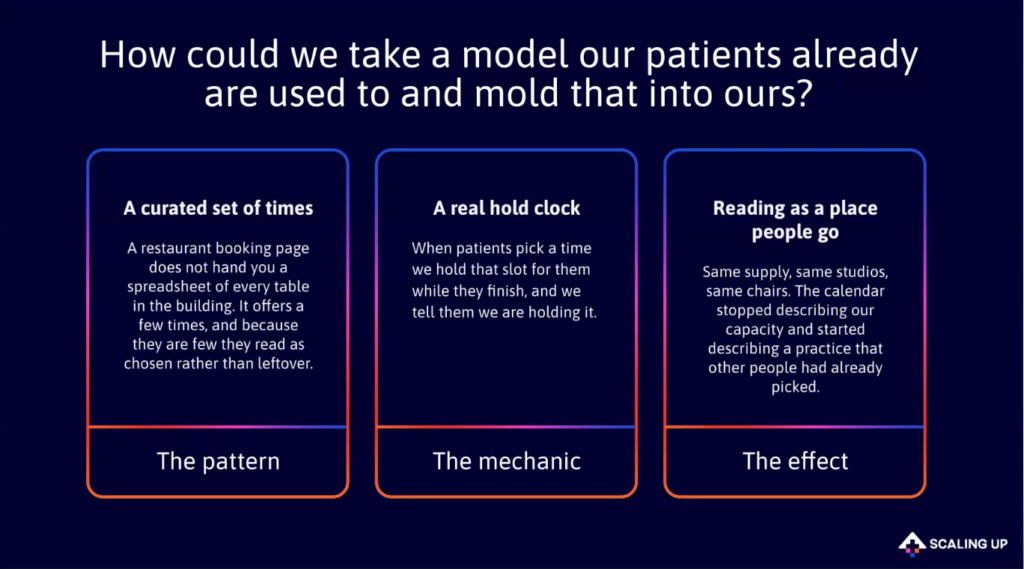
Instead of presenting every available appointment at once, Tend shows a curated selection of real-time slots, with the full calendar available for patients who want more choices.
Kaela’s advice was to “measure to the chair, not the submit button.”
Grace Elliott, Director of Marketing at Orthodontic Partners, highlighted another challenge: appointment availability. Her team found an average booking window of 19 days, and kept-appointment rates dropped by approximately five percentage points when patients waited more than 10 days.
Then there’s speed to lead. Jesse Fiest, Director of Growth Marketing at Spring Fertility, was emphatic on this point. Healthcare marketers sometimes act as though patients will tolerate slower response times than consumers in other industries. But healthcare is no different. The provider that responds first and makes booking easy has a real advantage. If you’re slow to follow up, you risk losing that patient to someone who isn’t.
These examples all point to the same opportunity. Improving patient acquisition requires looking beyond advertising performance and working closely with operations to remove friction throughout the booking process.
After all, patient acquisition doesn’t end when marketing generates a lead. It matters whether that patient actually gets care.
Looking ahead to 2027
Four years ago, so much of the conversation at Scaling Up centered on figuring out how to measure healthcare marketing effectively and responsibly. This year, we heard from organizations that have done the hard work of building those capabilities. Now they’re forecasting growth, testing new channels, improving patient experiences, and making more informed investment decisions.
There’s still plenty to figure out. AI is changing how patients research care, how advertising platforms operate, and how our own teams work. We’re seeing marketers explore patient advocacy programs, creator partnerships, TikTok, and new approaches to demand generation.
What gives me optimism is that healthcare marketers are becoming better equipped to test those ideas and understand what works. With the right data, we can make smarter investments. We can see which messages resonate with patients, which channels introduce people to our brands, and where the experience breaks down before an appointment is booked.
And we can bring those insights back to the people responsible for delivering care.
That’s what I hope we carry into 2027: the confidence to experiment, the discipline to measure what matters, and a willingness to keep looking at the experience through the patient’s eyes.
We’ve spent years building the foundation. I’m excited to see what we do with it next.
See you at Scaling Up 2027.
And to close, a special thank-you to our presenting sponsors, Liine, Freshpaint, and Patient Prism, for helping make Scaling Up 2026 possible and supporting the conversations moving healthcare marketing forward.
