




Here’s the thing: healthcare marketing teams that ignore performance audits end up reactive instead of strategic. The gap between marketers who stay ahead and those who constantly firefight? It comes down to one practice—actually looking at what’s working and what isn’t.
Effective strategy isn’t just about throwing budget at channels. It’s about knowing your performance metrics, understanding capacity, and measuring the right things. We see organizations that do this regularly pull ahead. The ones that skip it? They spend the year solving problems they could have prevented.
This framework hits on six areas we consistently find during audits that are either gaps or missed opportunities. You can review these in 15 minutes. Acting on them? That takes real work. But it’s the work that moves the needle.
The Audit: 6 Critical Checkpoints
Use this to assess your program’s actual health. These aren’t theoretical—they’re the patterns we see across multi-location providers, health systems, and specialty practices every single day.
1. Are your marketing investments aligned with operational capacity?
Here’s a pattern we see too often: you’re driving patient demand to locations that are already packed. Meanwhile, your practices with actual availability are getting minimal support. That’s wasteful marketing spend and a terrible patient experience.
What to look for: Do you have practices with six-week wait times while others are actively looking for patients? Are you running campaigns in markets where providers are booked solid, while locations with open slots get nothing? If you’re seeing that kind of mismatch, your media spend isn’t aligned with reality.
How to address it: Talk to your operations team. Actually talk to them—not a one-time check-in, but regular communication about capacity across locations and service lines. Build a framework together to categorize each location by availability and adjust your budget accordingly.
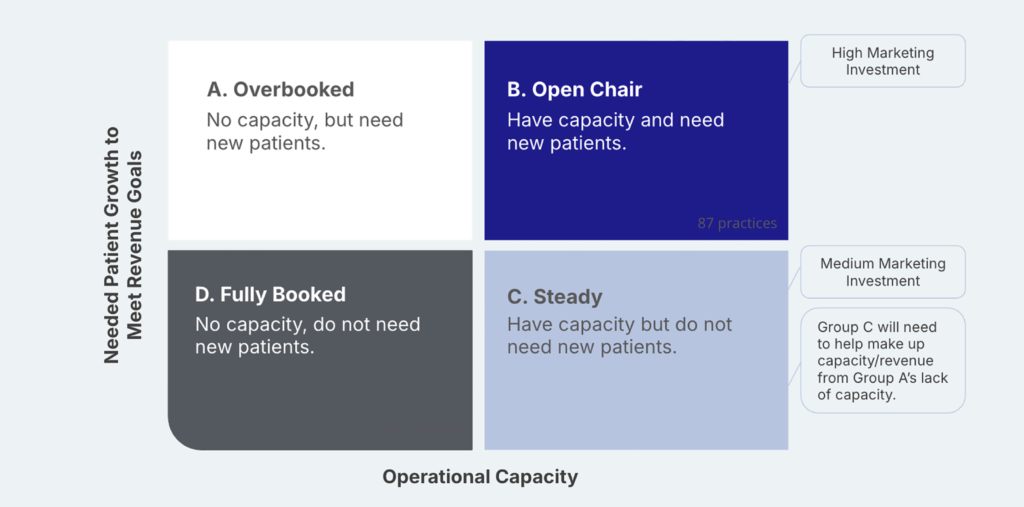
The numbers speak for themselves. When North American Dental Group aligned capacity-driven marketing across 200+ locations, they saw a 288% increase in patient bookings and a 54% drop in cost per acquisition. They simply moved budget away from overbooked locations toward practices with available slots.
Set up a tiering system with ops: no capacity = minimal spend. Capacity available = proportional investment. Reassess regularly because capacity changes.
2. Do you have a data-driven measurement framework?
Most healthcare organizations are flying blind on at least part of their data. You’re optimizing toward form fills instead of actual bookings. Your call tracking doesn’t distinguish between someone asking for directions and someone scheduling an appointment. Your data breaks somewhere between click and conversion.
What to look for: Can you actually track a patient from initial click through to appointment booking to visit completed? Or does your data chain stop halfway? Are you optimizing based on preliminary interactions (form submissions, clicks) or real business outcomes? Can you see which channels drive high-value patients versus high-volume, low-intent traffic?
How to address it: Audit your tech stack. You probably need three things: (1) HIPAA-compliant conversion tracking that captures actual patient actions—booked appointments, completed visits; (2) call tracking that knows the difference between an inquiry and a booking; (3) CRM and EHR integration so you see the full patient journey.
Solutions like NexHealth transfer appointment data directly to your ad platforms. Call tracking tools like Invoca and Liine use AI to categorize calls by what actually happened. Setting this up takes months, so start now.
Here’s why it matters: a form request for directions is completely different from a phone call that results in an appointment. Most tracking systems treat them the same. Your measurement framework should reflect what actually drives revenue.
3. Does your media mix create sustainable competitive advantage?
Dumping 80% of your budget into Google Ads? You’re vulnerable. One algorithm update, one policy change, and your acquisition strategy tanks. Not to mention it’s inevitable you’ll eventually see diminishing returns.
What to look for: What percentage of your budget goes to Google Ads? Above 70-80% is overconcentrated. Check your impression share—consistently above 80-90%? You’re hitting saturation. Watch for the signs: rising CPCs, conversion rates dropping as you bid on lower-intent keywords, quality scores declining.
How to address it: Run incrementality testing to find your saturation point, then systematically test other channels. These tests take 4-8 weeks. Try Meta for awareness, Performance Max for omnichannel reach, programmatic display for targeted prospecting. The goal is channels that complement what you’re already doing, not random platform sprawl.
Incrementality testing answers what attribution can’t: if this channel disappeared tomorrow, would patients still convert? This testing is particularly valuable in healthcare because you’re not relying on pixels that create HIPAA headaches.
Good channel diversification is strategic. You’re testing new channels for specific reasons—reaching different demographics, testing creative approaches, building awareness that feeds your primary channels. It’s not just adding platforms to add platforms.
4. Are your campaigns optimizing for business outcomes?
When you optimize toward preliminary interactions instead of actual conversions, you’re training your algorithms on incomplete data. Everything downstream suffers.
What to look for: What’s your campaign actually optimizing toward? Booked appointments and completed visits? Or form submissions and clicks, no matter the quality? If you’re treating all leads the same regardless of outcome, your algorithms don’t know what matters.
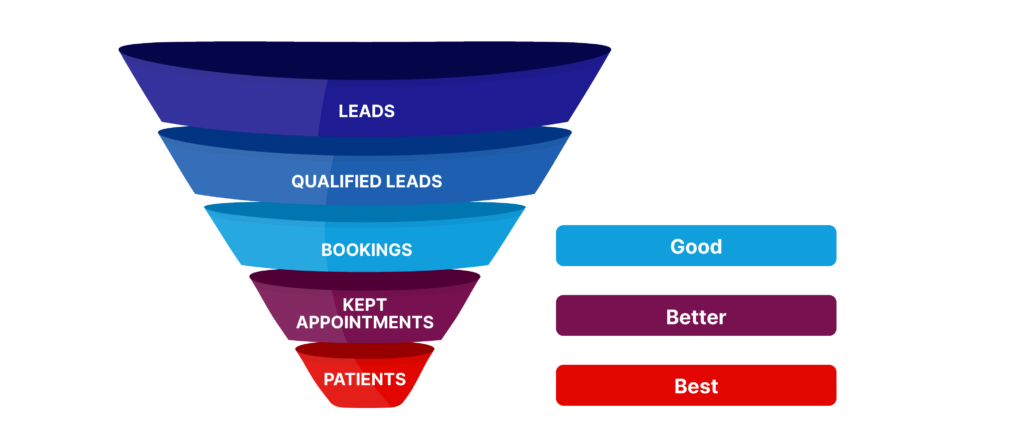
How to address it: Implement HIPAA-compliant tracking that captures true patient conversions. You must plan ahead here, as proper setup and compliance verification can take months.
The difference is real. A form request for directions isn’t the same as a phone call that books an appointment. Yet most systems treat them identically. That’s a problem.
Online booking platforms like NexHealth and call tracking tools like Invoca and Liine use AI to categorize what actually happened on those calls. That’s what you need to optimize toward—actual patient acquisitions, not preliminary interactions.
5. Is your brand visible in AI-powered search experiences?
ChatGPT, Google AI Overviews, Gemini—they’re capturing a huge share of patient searches now. If you’re only optimized for traditional Google search, you’re missing people searching for care.
Too many healthcare organizations pour everything into homepage SEO and ignore local pages, Google Business Profiles, and the signals AI actually cares about. That’s a missed opportunity.
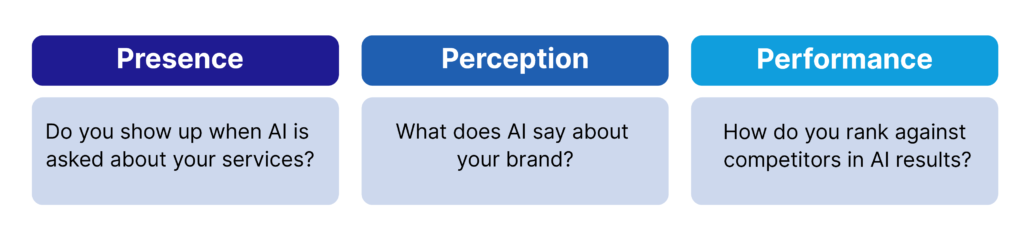
We use something called the 3P Framework to assess AI visibility: Presence, Perception, and Performance.
- Presence: Do you show up when AI is asked about your services? Audit this yourself. Use ChatGPT, Google AI, Gemini, Perplexity. Search patient-relevant queries like “Best dermatology near me” or “How to treat acne.” Ask follow-ups: “Why wasn’t [your organization] mentioned?” or “Compare [your organization] to competitors.”
Track two metrics: brand mentions (AI explicitly names you) and citations (AI uses your content as a source without naming you). Local healthcare? You own about 70-80% of the content influencing local AI responses. So, if there’s a gap, it’s usually fixable—as long as you know about it. - Perception: What does AI say about your brand? Ask the AI: “What does the internet say about [your organization]?” Request sources. This tells you how AI interprets your reputation based on reviews, social media, citations, and your website.
- Performance: How do you rank against competitors in AI results? Set benchmarks. Track monthly using AI monitoring platforms. You’ll see if visibility is growing, flat, or declining.
What to look for: Google Business Profiles with missing photos, inconsistent info, no FAQs, and minimal reviews. Location pages that are thin or don’t answer patient questions. Website content that doesn’t have the semantic richness AI systems want. No schema markup telling AI what your services actually are.
But here’s what most organizations miss: AI doesn’t just pull from your website. It pulls from YouTube, Reddit, PR placements, social posts, images, listicles—everywhere. If you’re only optimizing your site, you’re leaving visibility on the table.
How to address it: Start with presence audits; these take a few hours, but give you immediate insight. Then optimize systematically across multiple channels:
- On your website: Build local content depth. Answer the questions your patients are actually asking using question-format content, how-tos, and expanded FAQs. Implement schema markup for services, providers, reviews, and FAQs. Write semantic content that’s specific and aligned to what AI actually surfaced for similar queries.
- Beyond your website: Expand into YouTube and video content, as AI surfaces video results prominently. Leverage digital PR and social joint posting to amplify authority. Create images, listicles, and one-pagers that AI can reference and cite. Build provider and leadership presence across digital channels—AI weights authority signals from recognizable people and brands.
- Entity and brand consistency: Make sure your brand information is accurate everywhere. Expand provider influence and local community presence. If you operate multiple locations offering related services in different markets, work efficiently at the top to hit broad topic pillars, then layer location-specific tactics that reflect each market’s unique competitive landscape.
Unlike traditional SEO that compounds over time, AIO content decays. It loses freshness and relevance. Prioritize updates across all these channels. Tools like Profound help you track AI visibility trends.
The organizations winning here invest in content quality across multiple channels, local authority, and structured data. Not just keyword stuffing on one website.
6. Does your patient journey deliver on marketing promises?
When your ad says “same-day appointments” but your scheduling system shows month-long wait times, you’ve created a mismatch. That wastes marketing money and drives patients to competitors.
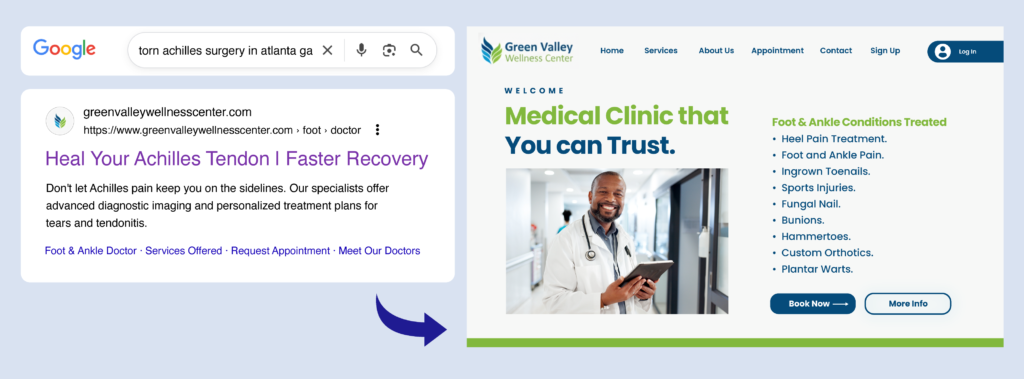
What to look for: Check your active campaigns against your actual landing pages. Does your ad promise same-day appointments when scheduling shows month-long waits? Are you highlighting providers who are actually at capacity? Beyond availability, do your landing pages offer the same service and expectations as the ad promises? If it’s not immediately obvious that they’re in the right place, users will bounce.
How to address it: Audit advertisement-to-landing page alignment systematically. Make sure scheduling availability, provider details, and service info match reality. What patients actually see should match what you promised.
This goes beyond landing pages. It’s the entire patient experience. Broken promises between ads and reality waste investment and push patients elsewhere.
From Assessment to Competitive Advantage
These six areas form your foundation for staying competitive. Organizations that audit regularly and act on gaps establish stronger positioning. Those who neglect this work spend their time constantly reacting.
Priority implementation areas:
- Secure HIPAA-compliant measurement infrastructure that lets you optimize for actual patient conversions
- Develop capacity alignment protocols with ops teams so marketing supports realistic patient volume
- Implement incrementality testing to validate channel expansion with real data
- Audit conversion tracking to find gaps between what you’re optimizing and what actually matters
- Evaluate channel concentration risk and build diversification strategically
- Audit message-to-experience consistency across all touchpoints
Healthcare marketing moves fast. Expectations increase. Competition tightens. Requirements expand. The organizations that succeed treat auditing as an ongoing discipline, not a one-time box to check. They audit regularly, find gaps systematically, and move decisively. That’s where the advantage lies.
