




You’re looking at your paid search dashboard, and the numbers look good. Cost-per-new-patient is at $150. Your goal is $200. Everything feels healthy.
Then leadership asks: “Should we increase the budget or try something new?”
That’s when you freeze. There are actually two separate questions hiding inside that one question.
- The first is a math problem: Has paid search hit its ceiling? Blended metrics like cost-per-new-patient can look healthy while your actual returns are quietly collapsing. Before you make any channel decision, you need to know whether your current investment is still working at the margin.
- The second is a proof problem: If search is maxed out, where does growth come from next? And how do you know a new channel is actually driving new patients rather than taking credit for ones you would have gotten anyway?
These are different questions that require different tools. Marginal economics tells you when you’ve hit the ceiling. Incrementality testing tells you what to do next: with evidence, not guesswork.
This article walks through both.
The illusion of health: Why your blended metrics lie
Let’s walk through a real scenario. You spend $22,500 on paid search and generate 150 new patients at a blended cost-per-new-patient of $150. You’re well within your $200 target.
So you double down. You increase spend to $45,000. Now you’ve acquired 250 new patients—100 more than before. Your blended cost is $180. Still healthy. Still under goal.
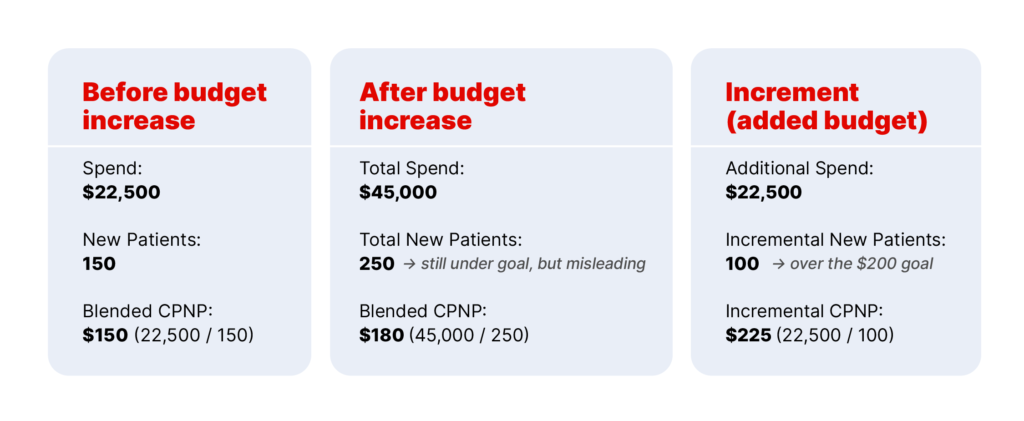
But here’s what leadership doesn’t see: Those 100 incremental patients actually cost you $225 each.
You spent an extra $22,500 and got 100 new patients. That’s $225 per patient. Over budget.
Blended metrics hide diminishing returns by averaging your best clicks with your worst ones. Early on, your paid search investment is highly efficient. CPCs are low. Conversion rates are strong. But as you scale, you capture less efficient clicks. Your blended cost can still look reasonable—trending from $150 to $180—while your actual incremental cost-per-new-patient skyrockets.
This is marginal economics. It’s where most healthcare providers get stuck.
Why attribution fails in healthcare
Here’s another problem attribution won’t catch: It measures correlation, not causation. When someone searches “dentist near me,” clicks your ad, and books an appointment, it’s easy to give search credit. But did the ad cause the conversion?
What if they would have found you through Google Business Profile anyway? In healthcare, patient journeys are complex. Someone might see your Meta ad on Monday, search your brand on Wednesday, click search on Friday, but not book until next week after they call and verify your insurance participation.
Which channel deserves credit? Google claims it. Meta claims it. Your attribution model picks a winner based on a rule. But none of these prove causation. They’re just allocation rules. When you’re making seven-figure budget decisions based on these rules, you’re essentially guessing.
The ceiling: Why search maxes out
Paid search works beautifully for healthcare—when you’re capturing high-intent patients actively searching for care. But eventually, you hit a ceiling. CPCs rise. Conversion rates fall. You’ve already captured the patients who were looking. The next patient costs more to reach and is harder to convert.
Imagine a regional dental group: CPCs increase from $8 to $12 in major metros. Conversion rates drop from 8% to 5%. Your blended cost-per-new-patient rises from $125 to $240. You’re no longer meeting your goals. Don’t view this as a failure. It’s the natural arc of performance marketing in a mature channel. The question isn’t: “Should we keep investing in search?” It’s: “Where should the next dollar go?”
That’s where incrementality testing comes in.
Incrementality: Moving from “does it work?” to “how much should we spend?”
Here’s what incrementality actually measures: Causal impact.
It answers the question, “What would have happened if we did nothing?”
Instead of relying on platform reports or attribution models, incrementality testing uses a simple scientific method. You create two matched groups—a test group exposed to a new marketing initiative and a control group without it. You measure outcomes. You calculate the difference. That gap is your incremental lift.
For healthcare providers, this is transformative. Because it moves the conversation from defensive doubt—”Does paid social actually work?”—to offensive strategy—”How much should we allocate to paid social?” That’s the difference between hesitating on a $200K budget decision and confidently deploying it.
The geo-lift test: How healthcare providers prove incrementality
Incrementality can be measured in several ways, including holdout tests, conversion lift studies, and geo-based experiments. For multi-location healthcare providers, geo-lift testing is often the most practical approach because it works at the market level, respects privacy constraints, and scales across locations.

The setup is straightforward. You identify markets that perform similarly based on baseline metrics: demographics, cost-per-click, conversion rates, and patient volume. You split them into test and control groups.
In test markets, you activate a new channel—say, paid social. In control markets, you hold out. Then you run the test for 4 to 6 weeks and measure outcomes. You’re not measuring leads. You’re not measuring website traffic. You’re measuring what matters: new patient appointments.
Why does this work for healthcare? Because geo-lift is privacy-friendly. It relies on geographic regions, not individual-level tracking. And it works at scale, which matters when you’re operating hundreds of locations.
The proof: What incrementality revealed
Let me share a real example we worked through.
A multi-location healthcare provider had maxed out paid search and Performance Max. Leadership wanted growth but was skeptical about paid social. The question: Could paid social actually drive net-new patients, or would it just serve impressions to people who would have booked anyway through search?
We designed a geo-lift test. Test markets ran paid search, Performance Max, and paid social. Control markets ran only paid search and Performance Max.
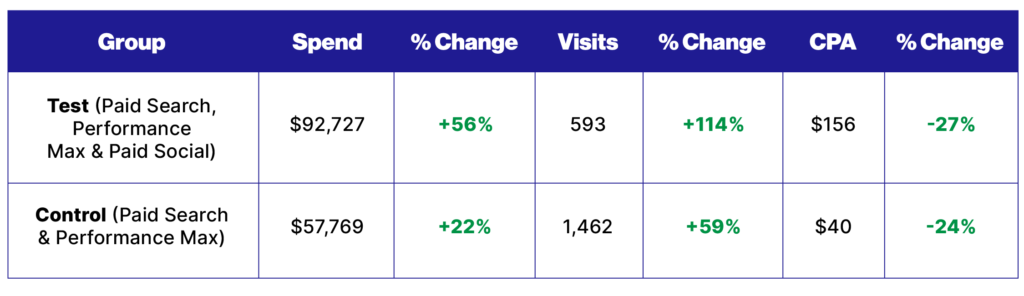
Over 42 days, the results were clear:
- Test markets: 114% increase in visits
- Control markets: 59% increase in visits
The 55-point gap is pure incrementality. Paid social was working—and working hard.
What happened next was just as important as the test itself. The conversation shifted. It went from “Does paid social work?” to “How much more can we invest in paid social?” The client rebalanced spend month by month. Paid social allocation grew from roughly 5% to over 20% within months. They scaled with confidence, not guesswork.
Your next steps: Start simple, scale what proves its worth
If you’re hitting the search ceiling, incrementality testing gives you a way forward, but only if the test is designed to answer a real business question. Most tests fail because they try to do too much, too fast. Here’s how to design a test that produces a clear, defensible answer.
Step 1: Test one meaningful question at a time
Don’t test three channels at once. Pick one. The channel your leadership is most skeptical about—that’s your highest-value test. If CFOs doubt paid social, test paid social. If they’re unsure about display, test display. Start with the channel that would have the biggest impact on your budget conversation if proven incremental.
Step 2: Identify matched markets
Your test and control markets must behave similarly before the test begins. That means aligning on fundamentals like:
- Demographics and population density
- Cost-per-click and competitive intensity
- Conversion rates and patient demand patterns
- Practice and service line capacity
If you operate 20+ locations, this is usually straightforward. With fewer locations, you may need to group geographic regions within larger markets. The goal isn’t perfection; it’s comparability.
Step 3: Define your success metric before you start
This matters more than you might think. Don’t measure leads. Don’t measure website traffic. Measure what actually drives your business:
- New patient appointments (scheduled)
- Kept appointments (patients who showed up)
- Revenue from acquired patients (if you can track it)
Get to the bottom of the funnel. The deeper your metric, the clearer the incrementality signal.
Step 4: Run long enough (4-6 Weeks minimum)
This is where most tests fail. Healthcare marketers pull the plug after two weeks because they’re not seeing results. Don’t do this.
Incrementality tests need time for statistical significance to emerge. You also need to account for variables such as seasonality, external events, and the ad platforms’ learning curves for optimization. Four to six weeks is the minimum. Eight weeks is better if you can afford it.
Step 5: Report lift, not blended averages
When results come in, resist the urge to report blended metrics. Instead, report incrementality directly:
- Incremental lift: Test market growth (%) − Control market growth (%)
- Incremental cost per acquisition: Additional test spend ÷ Incremental new patients
Present it to leadership this way: “Our test revealed that Paid Social drives an incremental CPA of $180—well below our $200 goal. We’re confident allocating $X to this channel because we’ve proven causation, not just correlation.”
That’s a conversation that moves budgets.
The testing cycle: don’t stop at one test
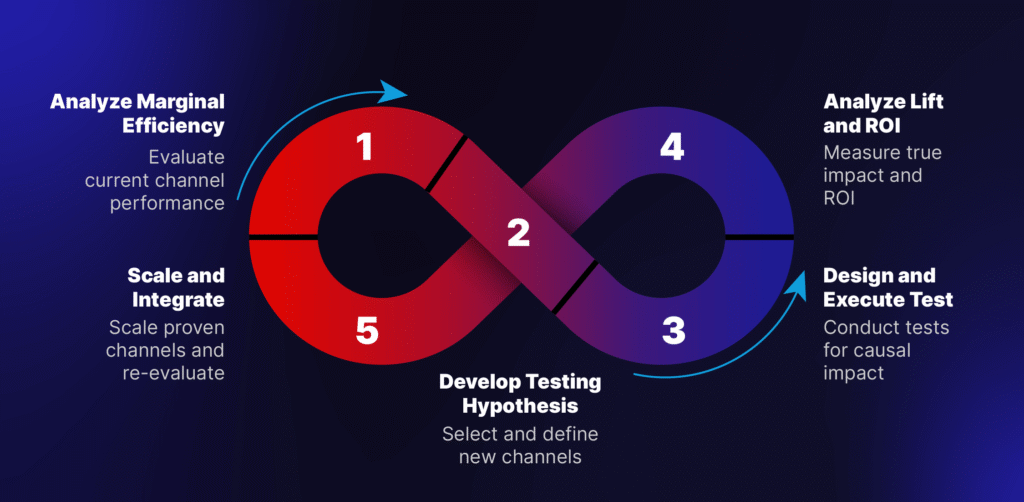
Incrementality testing isn’t a one-time project. It’s a framework. After your first test, you move into a cycle:
- Evaluate current performance (identify which channels are maxed out)
- Develop a testing hypothesis (pick a new channel and define success)
- Design and execute the test (4-6 weeks with matched markets)
- Analyze lift and ROI (measure true causal impact)
- Scale what works (rebalance spend to proven channels, then repeat)
This is how you continuously expand your media mix with confidence.
The confidence test
Incrementality testing turns guesswork into evidence and growth into a repeatable process. When you know your next channel is truly incremental—driving net-new patients, not taking credit for inevitable conversions—you can scale confidently. In healthcare, where every dollar is scrutinized and every appointment slot has value, that certainty matters.
The search plateau isn’t an ending. It’s a signal to thoughtfully expand. Incrementality testing is how you do it.
As organizations mature, advanced healthcare marketers combine lift testing with broader measurement approaches like media mix modeling and causal analysis to guide long-term investment decisions. Incrementality provides the proof. Advanced measurement turns that proof into a system.
Ready to go deeper?
This article covers the fundamentals of incrementality testing for healthcare organizations. But there’s much more to explore—from test design pitfalls to advanced measurement frameworks to scaling insights from real case studies.
Watch the full presentation from the Scaling Up: The Healthcare Performance Marketing Summit, where Alex Kemp, Senior Director of Analytics, walks through the complete methodology, shares additional case study results, and answers the most important questions healthcare marketers ask about incrementality.
