




I took the stage at Freshpaint’s House Call conference a few weeks ago to share something we’ve been working on with Novant Health. And I’ll be honest—it’s one of those projects that gets me excited about what’s possible in healthcare marketing when you’re willing to think bigger than “more leads.”
But this story is more than just the ideal destination. It’s about the journey. And more importantly, it’s about not waiting for perfection while you build something better.
The setup: A health system divided
Novant Health is one of the Southeast’s largest integrated healthcare networks—900+ locations across North Carolina and South Carolina, serving 7+ million patients annually. When they acquired a health system in South Carolina, leadership saw an opportunity to scale the brand in a new, high-growth market. But rapid growth requires the right measurement foundation to make smart decisions.
The SC operation had been running on Athenahealth EHR, where they inherited limited historical data. And, like most health systems, they had to remove all tracking methods when the HHS OCR guidelines required it, and visibility disappeared almost overnight.
Additionally, as the team pushes innovation toward becoming a more integrated operational healthcare system, the Novant Health team decided to migrate the inherited EHR to Epic by February 2026—the system already well established in their NC markets.
Enter, Allison Koch, Novant’s Digital Demand Manager, who asked a bigger question: What if we didn’t just replicate the North Carolina playbook? What if we treated the South Carolina region as a test case to build operational excellence, from the ground up? A place where Novant could own the data, maintain full visibility, and build a single source of truth that complements a sophisticated go-to-market strategy.
That’s exactly what they decided to do. And that’s where we came in as the SC region agency partner to help execute the media strategy and navigate their migration from Athenahealth to Epic
The journey: One step at a time (not waiting for perfect)
Here’s what most organizations do: They get the technology right, then they optimize. Novant did something different. They optimized at every step along the way.
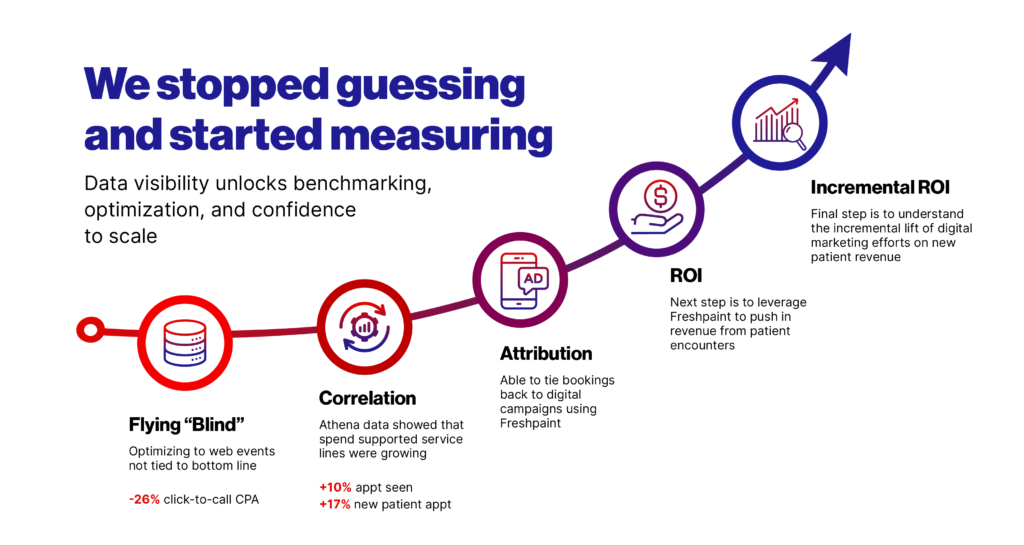
Stage 1: Flying blind
In the beginning, all they had were clicks and impressions. Those are the signals the ad platforms give you by default.
Alli was clear about this in our presentation:
“We did not have Freshpaint for six or seven months. So all the data that we had to present to providers who were experiencing an actual loss was clicks and impression share, and that is not ideal.”
This is the hard part. You’re spending money. You’re trying to optimize. But you’re essentially flying blind. You don’t know if clicks are turning into booked appointments. You can’t tie spending to outcomes.
But we didn’t just wait. We made improvements anyway.
Stage 2: Building blocks toward better measurement
Before Novant could move to real attribution, they needed to solve a fundamental problem: how do you get patient outcome signals to ad platforms in a privacy-compliant way?
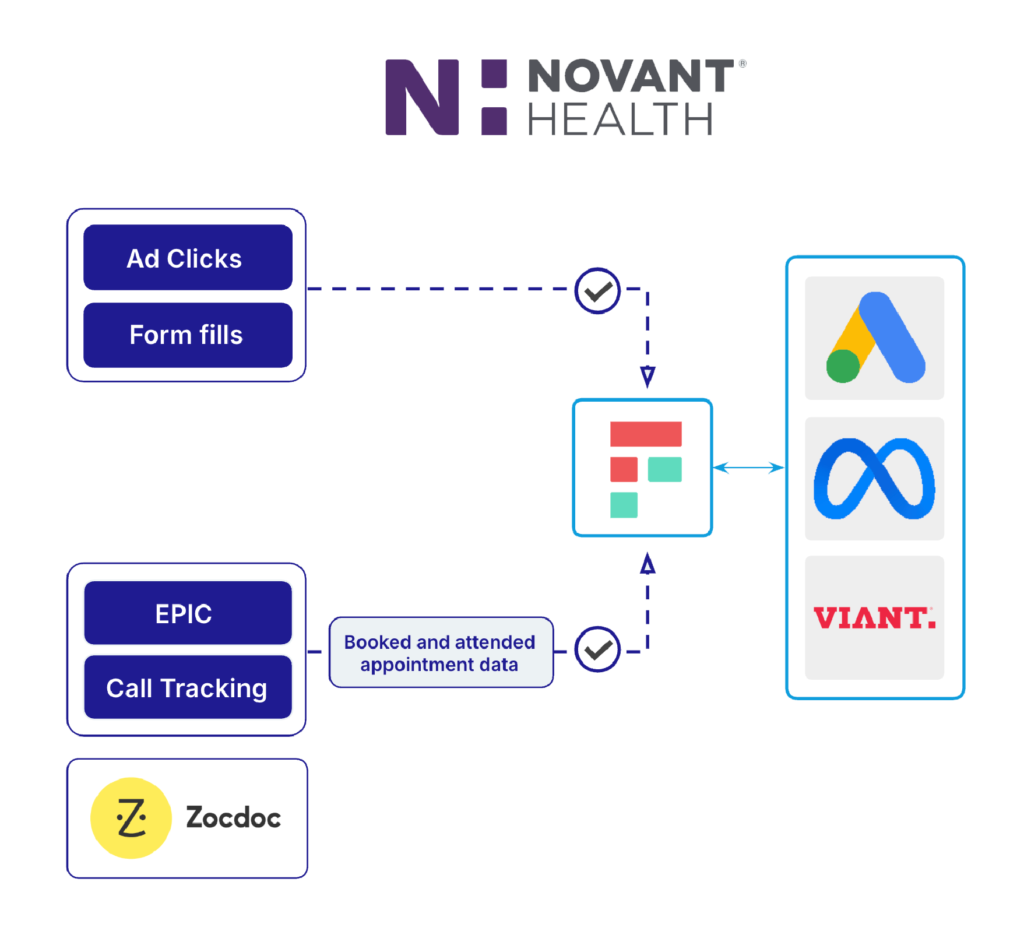
The martech framework consists of three interconnected pieces:
Privacy-safe data transmission. We needed patient outcome signals flowing from Epic back to ad platforms without exposing PII or violating HIPAA. Freshpaint became the central performance and compliance layer in the stack—a privacy-first CDP that ingests outcome data from Epic, strips or transforms sensitive fields, and activates HIPAA-safe conversion signals across Google Ads, Meta, and programmatic platforms.
Deeper conversion signals. Ad platforms operate on machine learning. They optimize toward what you tell them to optimize toward. If you only feed them clicks, they learn to drive clicks. Feed them patient outcomes, and they learn to drive patients.
The signal depth reality. Here’s what matters more than people realize: Not all service lines can optimize to the same conversion signal depth.
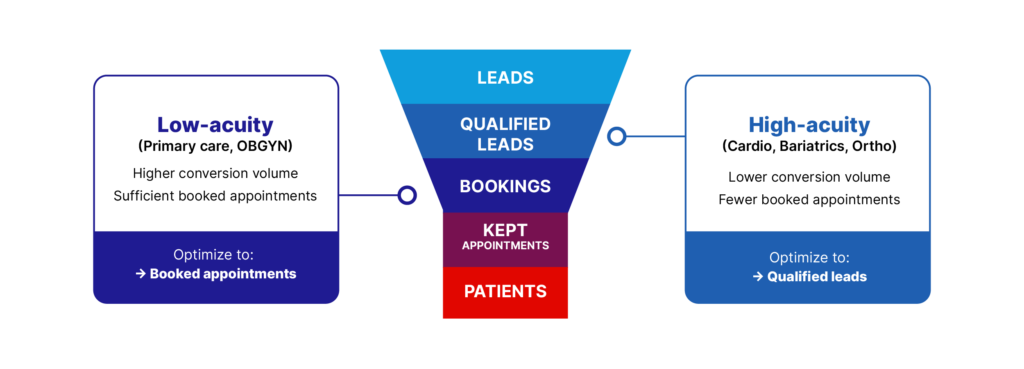
High-acuity services like Cardiology get 10-15 booked appointments per month. If you tell Google Ads to optimize to kept appointments or new patient status, you’re starving the algorithm of data. It can’t learn from only three data points per month.
Low-acuity services like Primary Care get 500+ booked appointments per month. Same platform, completely different data picture.
So we built a flexible strategy:
- High-acuity services optimize to qualified leads
- Mid-volume services optimize for booked appointments
- Low-acuity, high-volume services optimize to patient outcomes and new patient status
If you turn your campaigns from hundreds of lead signals to three new patients a month in a high acuity service line, the algorithm won’t work. There simply isn’t enough data to support algorithmic decision-making from ad platforms. You have to thread the needle—ensuring there’s enough data while keeping signals as qualified as possible.
Stage 2 (continued): Correlation through historical data
As Novant Health evolved its infrastructure, Cardinal used the data we had to evaluate and optimize performance by comparing service lines that received digital spend with those that didn’t. What we found was reassuring: Service lines that received digital investment outgrew those that didn’t. We were allocating ~30% of the budget to supported service lines, and those lines were seeing 30% year-over-year growth. That validated at the highest level that digital marketing was working.
But here’s the limitation: We couldn’t do anything other than say, “It’s working, we can spend more money there.” The algorithm didn’t know which leads turned into booked appointments. The data was siloed—stuck between our platform dashboard, spreadsheets, and Athenahealth. But that didn’t stop us from making better decisions with what we had.
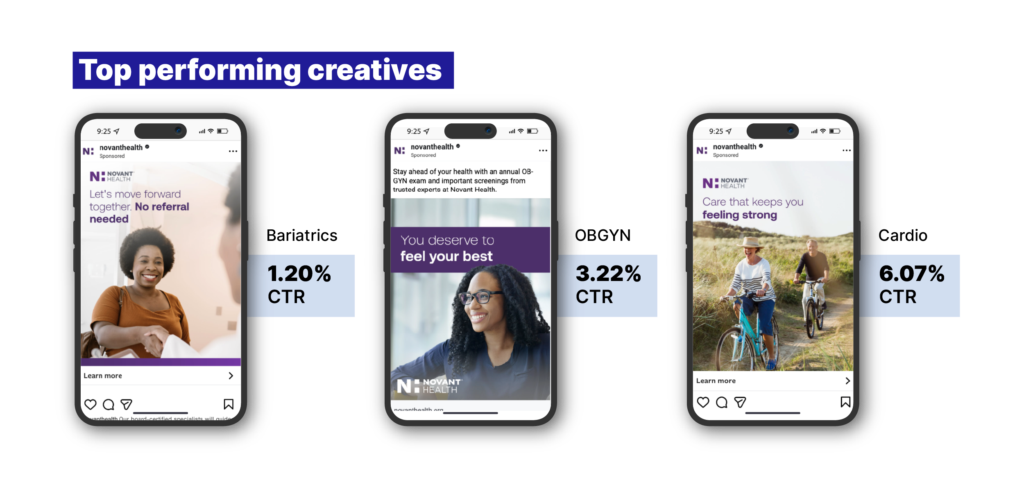
So, we tested creative. We optimized messaging. We structured campaigns by service line. Together, we didn’t wait for perfect data to start improving.
The results started to shift. Click-to-call CPA dropped 26%. Appointments seen have increased 10%. New patient appointments grew 17% across supported service lines.
By service line:
- Bariatrics: +55% new patient appointment growth
- Orthopedics: +30% new patient appointment growth
- OB/GYN: +10% new patient appointment growth
Stage 3: Attribution (the unlock)
Then Freshpaint went live alongside a rebuilt martech stack.
Now, data could flow from Epic to Google Ads, Meta, and Viant. The algorithm could finally see what Novant already knew: service lines that received investment were growing.
And the algorithm could learn. It could adjust bids and optimize toward booked appointments instead of clicks. Alli put it this way:
“Freshpaint and our GA4 went live at the same time. And that, even with using more shallow insights, was a huge win for us because we had to step deeper into being able to identify and tag important conversion elements, apply a value or weight to them, and really tell the algorithm that one step closer as they’re engaging with our clinics, how do we see value?”
The bigger picture: This is a measurement maturity curve
The way I think about this—and what Alli and I talked about at House Call—is that measurement maturity isn’t a switch you flip. It’s a curve. And Novant is on that curve, moving forward.
Here’s how it progresses:
- Flying blind: Clicks, impressions, no connection to outcomes
- Correlation: Using historical data to see patterns, but no algorithm feedback loop
- Attribution: Real conversion signals feeding back to platforms for optimization
- Incrementality: Understanding true incremental impact beyond baseline (hold-out tests, market match tests)
- ROI & beyond: Full marketing mix modeling, patient lifetime value, true incremental ROI
Novant is in stage 3 and moving toward 4. They’re not at stage 5 yet, but they’re not waiting. They’re making improvements at every stage.
What this unlocks
For Novant, advancing their measurement maturity creates three immediate capabilities:
- Benchmarking. They can compare performance across channels, service lines, and regions with precision. Which specialty drives real patients? Regional performance is transparent.
- Optimization. They can shift budget toward channels driving patient outcomes, not vanity metrics.
- Confidence. They can prove marketing ROI to internal stakeholders. They built business cases for expansion. They justified investment to the C-suite with data instead of assumptions.
But there’s a fourth unlock: permission to test.
Before, new channels felt risky. Meta? Programmatic? TikTok? Too much guessing. With better measurement capabilities, channels become opportunities. You run pilots. You measure impact. You scale winners. That’s when growth accelerates.
Getting alignment across functions
Here’s the challenge that every marketer in the room acknowledged, yet often gets overlooked. The measurement infrastructure is maybe 30% of the work. The other 70% is getting your organization aligned on the journey.

The hard part involves bringing everyone else along with you, because not everybody’s coming into the office thinking about measurement. You’re navigating Legal (HIPAA compliance), Finance (building the ROI model), IT (evaluating security and data flows), and Operations (managing an EHR migration while managing the day-to-day realities of a health system).
That’s the real story. Alli championed this work across multiple functions. She understood what each stakeholder needed to hear. She made the case for ownership over shortcuts.
And she understood something critical: You don’t wait for perfection. You move forward one step at a time. You celebrate wins along the way.
This is just the beginning
Novant is in stage 3 of measurement maturity. But we are nowhere near the end of that journey.
What comes next:
- Incrementality testing to understand true channel impact
- Marketing mix modeling to optimize across the full funnel
- UX and conversion optimization on landing pages and post-click experiences
- ZocDoc integration for physician scheduling signals
- True incremental ROI understanding across all channels
What started as “we need to know if clicks turn into patients” has become a platform for continuous growth.
Alli said something at House Call that stuck with me: “Healthcare projects are long. But they’re important. And even though the work doesn’t move fast, it does move forward.”
That’s the truth. This wasn’t a 90-day project. It’s a multi-year transformation. But every quarter, they get smarter. Every phase, they optimize. Every stage, they move the needle.
Why this matters for you
If your health system faces the gap where you’re investing in media but can’t connect it to outcomes, you’re optimizing toward proxies instead of reality. Measurement fundamentally shapes your strategy. It affects everything: channel testing, budget allocation, stakeholder confidence, and growth potential.
Most health systems are somewhere on this measurement maturity curve. Some are still flying blind. Some have correlation but not attribution. Some have attribution but not incrementality.
The question isn’t whether you move forward. It’s how fast you start moving, and whether you’re willing to optimize at every stage while building something better. We work with health systems to build privacy-safe measurement infrastructure, align conversion strategy to service-line economics, and operationalize media strategies that drive real patient growth.
If you’re ready to start the journey—not wait for perfect—let’s talk.
