




The most common mistake we see in de novo launches has nothing to do with creative or channel mix. It’s the timeline. A new location is 3 weeks from opening, the media brief just went out, and someone is picking a go-live date for paid search. It feels like progress. It isn’t.
A brand new location in a new market has no awareness, no search history, and no conversion data. Launch paid search close to opening day, and you’re asking the algorithm to optimize for signals that don’t exist yet. Budget burns while the system learns. Bookings eventually come in, but when you check the patient-origin data, half were already going to an existing location nearby.
We’ve run enough of these launches to know what separates a practice with a booked schedule in the first month from those that spend their first quarter playing catch-up. It comes down to building a 3-phase paid media strategy built around the opening, with measurement infrastructure at its core.
Matt Fitzgerald, CMO at Tend Dental, put it plainly at the Scaling Up summit:
“You have to have a bunch of patients in the pipeline before you’ve even opened your first door.”
Why the standard playbook falls short
The pattern is almost always the same: wait until the location is close to opening, spin up search and PMAX on a launch date, and hope it works.
Three things go wrong with this approach:
No awareness means limited demand – A brand new location in a new market has zero recognition. Nobody is searching for a clinic they’ve never heard of. If you haven’t built any awareness before launch, search volume in that neighborhood will be thin, and your campaigns will struggle to find people worth converting.
Measurement gets patched in after the fact – Conversion tracking, call routing, and CRM integration are usually treated as post-launch cleanup items. Smart bidding in Google and Meta depends entirely on the quality of the signals flowing back into the platforms. Start with no signals, and you’re paying for the algorithm to learn on your budget.
Evan Ilgenfritz, our VP of Paid Media, is direct about this:
“Conversion signals and measurement are truly 50-plus percent of the game.”
Without that infrastructure live and tested on day one, your Phase 2 is already behind.
Cannibalization goes undetected – Open a new location about 5 miles from an existing one, and the new location can fill up by pulling patients from the location next door rather than acquiring new ones. Most healthcare groups never check that. They see bookings at the new location and call it a win. The combined patient volume is flat, and the business hasn’t grown.
The 3-phase framework
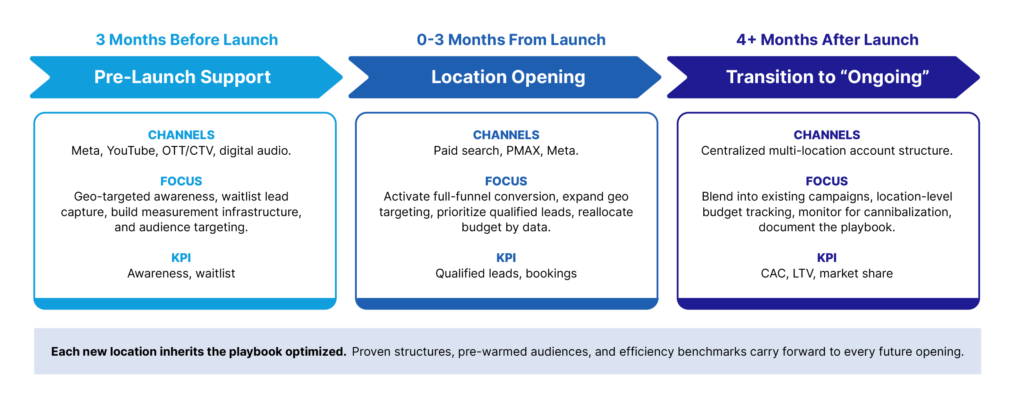
Every de novo we run sits inside the same 3-phase structure, each with its own goals, channel mix, and a way of measuring success. The phases aren’t independent. Skip one and the next starts cold.
Phase 1 – Pre-launch (3 months before opening): Build awareness in the local market. Get prospective patients into a waitlist. Get the measurement infrastructure live and tested.
Phase 2 – Location Opening (launch month): Activate the full funnel. Flip the switch on conversion campaigns. Lean on the awareness you built.
Phase 3 – Transition to ongoing (months 1-3 and beyond): Normalize spend. Fold the new location into the broader account structure. Watch for cannibalization. Document what worked for the next opening.
Each phase is designed to set the stage for the next one. Skip phase 1, and phase 2 will start cold. Rush phase 2 without a solid measurement setup, and phase 3 will have nothing reliable to build on. The sequence matters as much as the tactics.
Phase 1 – Pre-launch: build awareness before you need patients
Three months is the right pre-launch window for paid media. Long enough to build recall in the local market. Short enough that people won’t forget you by the time the doors open.
Kim Craven, from Ethos Veterinary Health, nailed it on a recent Ignite podcast episode:
“We usually have about a six to nine-month plan to launch going into the market. That’s getting together what the brand looks like, what the strategy is in that particular market, then starting to set up and seed that marketing several months out.”
For most growth-stage healthcare groups, 3 months of paid media pre-launch is the right starting point—enough runway to build demand without over-investing before patients can book.
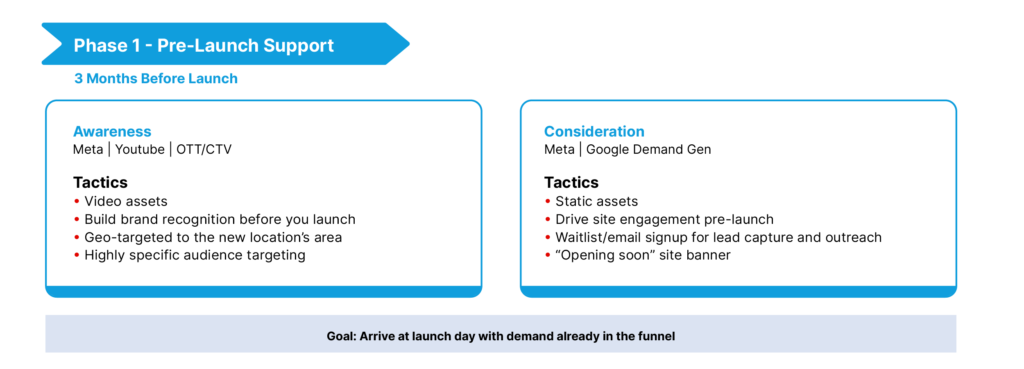
Upper-funnel channels do the work here. Nobody searches for a clinic that hasn’t opened yet. Meta, YouTube, and OTT/CTV build brand awareness. Google Demand Gen and Meta static ads push people a step further, driving website visits, seeding remarketing audiences, and capturing waitlist signups.
Keep targeting tight. Focus on the neighborhoods and zip codes the new location will serve. You’re trying to build recognition among people who could realistically become patients. Broad targeting at this stage wastes spend on people who will never walk through your clinic’s door.
Build a waitlist. A simple lead-capture experience feeds warm leads directly into your CRM. By opening day, the location has a list of people who have already shown interest. It won’t show up in your ad platforms, but it’s one of the most valuable things pre-launch media can produce.
Get measurement live before Phase 2 starts. Conversion tracking, call routing, CRM integration, and location-level reporting all need to be working before the doors open. This is non-negotiable. If they’re not, you’ll be patching them in as you go, and your campaigns during Phase 2 will pay the price.
Phase 2 – Launch: open for business
When the doors are open, the booking experience is live, and the call center is staffed, the brand can credibly ask people to book. Everything you built in Phase 1 was for this moment.
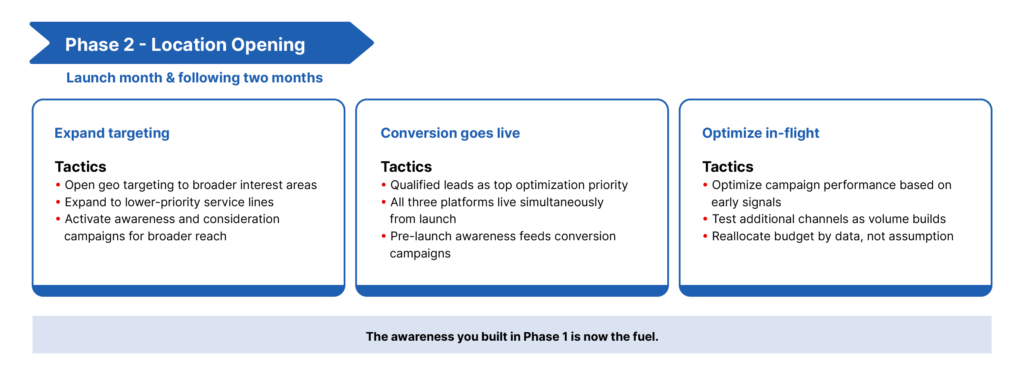
This is when Google, PMAX, and Meta conversion campaigns go live. The upper-funnel work from Phase 1 doesn’t stop—it keeps running and feeds those conversion campaigns with the audience you’ve spent the previous 3 months building. By the time someone sees a “book your appointment” ad, they’ve already seen the brand before. This familiarity is what gets them to act.
Creative pivots at this stage. The pre-launch message was “we’re coming.” The launch message is “book your appointment.” Same brand, different CTA. This is also the moment to expand geo-targeting.
PMAX is a good fit, with one condition. We’ve seen it work well for de novo launches when conversion signal quality is high. Without quality signals flowing from your CRM and call-routing setup, it’s going to optimize toward whatever it can find, and you won’t like what it does.
As Evan puts it:
“As soon as you get qualified lead signals in the mix, it opens it up. The conversion signal changes it entirely.”
Make sure the measurement setup from Phase 1 is in place before you rely on it.
Measurement infrastructure comes first. If tracking, call routing, and CRM integration aren’t live on day one, smart bidding starts cold. This is the most expensive mistake we see in Phase 2. The algorithm optimizes toward whatever signals it receives. The first 30 days of a de novo launch cost real money. You want the algorithm learning from signals that reflect patient quality.
Phase 3 – Transition to ongoing: make it stick
By 2 or 3 months after launching, the location has moved past its opening. “Now open” creative has done its job. The message shifts from announcing the location to filling its schedule, and the media structure shifts with it.
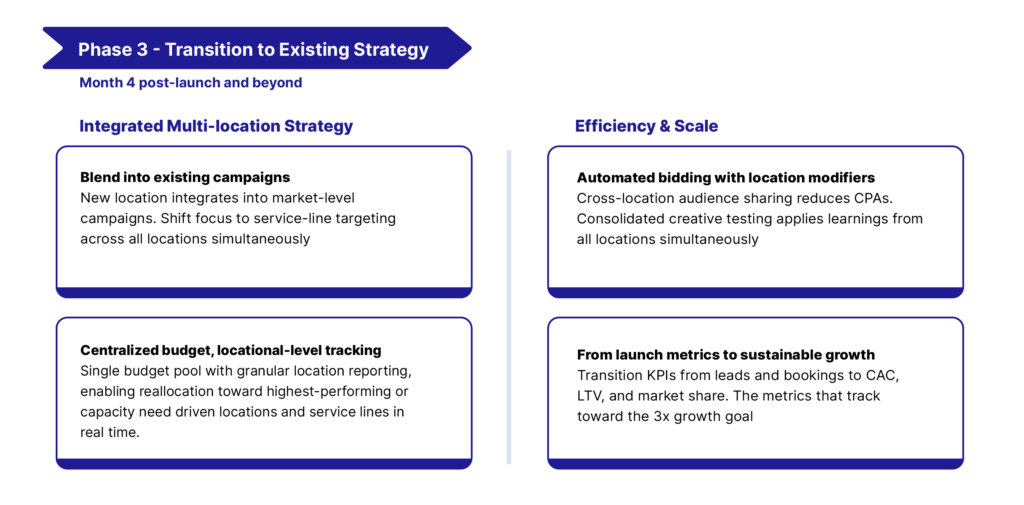
Fold the new location into a broader account structure. Keeping it in a permanent launch silo means you can never compare its performance against your other locations. One centralized account with location-level tracking lets you see where patients are coming from, where capacity exists, and where to shift spend as conditions change. That’s what makes a multi-location program manageable as you scale.
Check for cannibalization. When a new location opens near an existing one, it will inevitably pull some patients from that location. The question is whether it’s also bringing in patients who wouldn’t have come to you otherwise, or simply splitting the same patient pool across 2 locations. Track booking volume and patient-origin ZIP codes at nearby existing locations in the weeks after launch. Volume dropping at the existing location in proportion to gains at the new one is most likely redistribution, and it changes how you allocate budget across both locations.
Document what worked. Every de novo you run through this framework generates benchmarks for the next one:
- Which channels built awareness fastest
- What waitlist conversion rate to expect
- How long Phase 2 took to stabilize
Proven audience structures carry forward. Budget forecasts get more accurate. Each launch gets faster and cheaper than the one before, which is the real payoff on building the playbook properly the first time.
Build the playbook before you need it
Most teams start thinking about their de novo paid media strategy 30 days before opening. Pre-launch gets compressed to nothing. Measurement gets patched in after the fact. The first 90 days post-launch are spent making up for decisions that should have been made months earlier.
The 3-phase framework in this article exists to solve that problem. Three months of pre-launch investment in awareness, waitlist capture, and measurement changes what opening day looks like. The location opens with people already waiting to book, conversion campaigns with something to optimize against, and enough visibility to catch cannibalization before it flattens your growth numbers.
If you’ve got a de novo on the calendar and want a second set of eyes on the media strategy before the brief goes out, that’s exactly the kind of work we do. Let’s talk.
