




PMAX is one of the most powerful tools in healthcare paid media right now. But it’s only as smart as the signals you feed it. Give it a narrow creative set, and you get a narrow optimization loop. The platform learns quickly, reaches a ceiling, and stalls there.
AEG Vision—one of the largest optometry groups in the U.S.—was running a well-managed PMAX and Google Ads program. Their creative was strong, their campaigns were performing, and bottom-of-funnel demand was being captured effectively. But the creative pool was concentrated on high-intent users: people already close to booking an eye exam. But high-intent users are a limited pool, and PMAX can only scale as far as that pool allows.
The path forward was up the funnel, reaching patients before they were actively searching.
And to do that, you can’t just scale the same creative upward. High-intent messaging doesn’t resonate with someone who hasn’t yet connected their blurry screen to a reason to see a doctor. You have to meet people earlier in that journey with creative built around the why behind seeking eye care, those small, relatable moments that happen long before someone types “eye exam near me.”
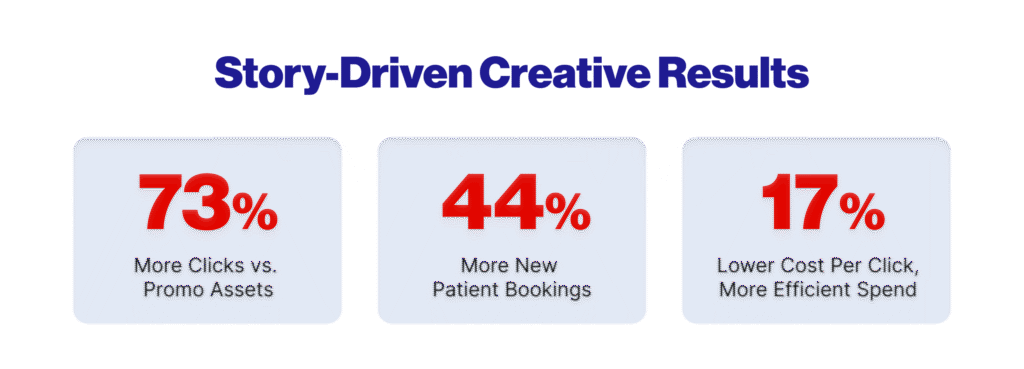
That’s the work we did with AEG Vision. Expanding their creative mix inside PMAX drove a 73% increase in clicks, 44% more patient bookings, and a 17% drop in cost per click.
Ad platforms are changing. Creative must change with them
PMAX is designed to learn. The platform is constantly evaluating which creative combinations, placements, and audiences drive engagement and conversion, then using those signals to shape how future impressions are delivered.
That makes creative one of the primary inputs into how the system learns. Give it a limited set of assets, and you get a limited set of signals. But give it more variety, and the platform has more to learn from and more ways to optimize.
Conversion-based ads still matter. They capture high-intent users who are close to taking action. The problem is that relying on them alone gives PMAX too little to work with. The platform can’t learn what resonates with patients in the early stages of their journey. Performance stalls because PMAX isn’t receiving enough variety to keep improving.
For AEG Vision, expanding that creative mix was the clearest path to improving efficiency within a channel already working.
The insight behind the work
The strategic insight here was rooted in what was happening earlier in the patient journey, before high-intent behavior ever kicks in.
The way patients experience vision issues rarely matches the way healthcare brands talk about them.
Vision changes tend to creep up slowly. A phone screen that needs to be held a little closer. Squinting at a menu. A photo that should’ve been sharper. These small moments are easy to dismiss and rarely acted on.
Traditional healthcare ads tend to lead with awareness, explaining the condition, listing the symptoms, and prompting an action. But awareness wasn’t really the barrier here. Recognition was. Patients were having the experience, but they just weren’t connecting it to a reason to seek care.
That gap was the creative opportunity.

What we focused on
Our goal wasn’t to redefine their channel mix, much less shift spend; it was to better support what was already working by feeding a more diverse set of creative inputs into PMAX.
Here’s how we approached it:
Introducing evergreen, story-driven creative
Rather than leading with a promotional offer, we built assets that connected AEG Vision’s services to real, authentic everyday patient experiences. The content was designed to engage users who weren’t actively searching but could recognize themselves in the message.
Building for platform behavior
Assets were structured with early hooks to capture attention fast, a clear brand introduction, and formats that match how PMAX distributes content across placements.
Creating at scale
We created multiple concepts across video and static formats, building a system of creative rather than relying on a single one-off ad.
As Jean Zhang, Senior Creative Director at Cardinal Digital Marketing, puts it:
“The main objective was to give the platform more ways to learn and optimize.”
“Is this you?”
One concept we developed from that insight was “Is this you?”
Instead of explaining vision issues or pushing patients to book an exam, the creative shed light on those familiar, everyday moments and framed them as a question. A touch of light humor. All relatable scenarios. An early hook that invited the viewer to recognize themselves rather than receive a call to action.
As Jean puts it:
“We leaned into what we know works: an early hook and a relatable question that immediately grabs attention.”
This was one of several concepts we built. Results weren’t driven by a single execution, but by the system we’ve developed.
What the platform did with better inputs
The first signal was engagement. CTR climbed to roughly 3% compared to under 1% with previous assets. That number carries more weight than it looks, because it’s the signal that tells PMAX the creative is resonating with the audience and is worth scaling.
As Jean explains:
“The platform didn’t just receive better creative, it received more usable signals.”
From there, the impact started to compound. Stronger engagement helped the platform identify higher-performing combinations and distribute them more efficiently. Greater creative diversity gave it more to test and learn from. By the end, clicks were up 73%, patient bookings had grown by 44%, and cost per click had dropped 17%.
What this means for your performance creative strategy
Here are a few takeaways from this work that apply across healthcare paid media.
- The platform can only optimize what you give it: Creative diversity is a performance input. A limited asset pool holds back what PMAX can learn and, in turn, what it can deliver.
- BOF creative has a ceiling. High-intent messaging captures the patients who are already close to converting. To grow beyond that pool, you need creative that meets patients where they are earlier in their journey, before they’re actively searching.
- People still respond to content that feels human: Even inside a fully automated system, the creative that performs is the one that resonates. Humor, relatability, and genuine and authentic human moments drive engagement in ways promotional messaging will probably never do.
- Build a system, not a one-off ad: One strong execution isn’t the goal. A range of diverse assets that give the platform multiple alternatives to learn from is what truly scales.
- Watch CTR early: It was the leading indicator for AEG Vision, and it usually is. It’s not a vanity metric, but often the first signal that something is working, and the input that fuels what comes next.
Creative is how the ad platforms learn
Automation has changed what drives performance in paid media. Campaign structure and targeting still matter, but the inputs you give the platform, especially creative, now play a bigger role than most teams out there realize.
For AEG Vision, the shift wasn’t dramatic. We didn’t reinvent the strategy. We identified what the algorithm needed to go further, and built a creative system that could deliver it. Evergreen, story-driven assets that met patients earlier in their journey gave the platform more signals to work with and let the system do what it’s designed to do.
That’s what the results reflect. And it’s where healthcare paid media is heading.
